
My job is to live in the liminal spaces.
My job is to recognize the unique core of every person I meet.
My job is to merge life and death until they are indistinguishable.
My job is to lie down in city graveyards.
My job is to stare at the trees dancing in the late August wind.
My job is to close my eyes and recognize the infinite grasping and gulping for air.
My job is to watch the blades of grass caress the cut stone of the graves, to absorb the desperation and intention with which humans desire permanence.
My job is to find people who will build me up and create a clear space for work and play.
My job is to stay clear on what my job is.
My job is to find ways to do my job.
My job is to remain open to new channels.
My job is to break myself open, again and again, trusting that I will always be whole, even as I fall apart.
My job is to expect nothing and everything all at once, forever.
My job is to be human and allow others to witness me being human.
My job is to create spaces for people to feel safe being human in concert with one another.
My job is to ask questions.
My job is to be part of nature.
My job is to gently unfold the blocks inside of me, inquiring into what might lie behind, underneath, and between them.
My job is to look at my hands in wonder.
My job is to use my hands to create music, writing, dance, thus communicating in the most direct way I know how.
My job is to feel the earth holding me.
My job is to discern discomfort from endangerment.
My job is to cherish the creative connections, friendships, and relationships I have been gifted with.
My job is to lead with honesty and compassion.
My job is to remain present with the stuff that feels ambiguous, confusing, murky, muddy, in between, and fuzzy.
My job is to translate the immediacy of life and death into art.
My job is to hold hope.
My job is to feel the seasons change.
My job is to let go of “shoulds” and find what feels good.
My job is to decorate Easter Eggs with tiny broken treasures I’ve slowly and intentionally collected over the years.
My job is to listen to the small voices, and report back.
My job is to commune with souls while “performing” (sharing, broadcasting, communicating) music and spoken word on stages, in living rooms, and in headphones.
My job is to turn towards the truth of being alive in the chaos.
My job is knowing myself well enough to know when something in my life is dying.
My job is to hold hands.
My job is to dance, sweaty and joyful, among people I love.
My job is to recognize the the sadness and hurt in others, and to hold space for it without becoming it myself.
My job is to lean into sensation if it’s pleasurable, and say no to sensation if it’s unwanted.
My job is to surrender to the mystery.
My job is to shout my humanness from the tallest hill where somebody and nobody can hear me.
My job is to follow the softness.
My job is to pull up my socks and keep going.
Tag: musician
Who are we responsible for?
“Emotional labor involves modifying our emotional expression – our speech, facial expressions, and body language – to satisfy organizational goals and requirements. For instance, we may need to outwardly express an emotion we aren’t actually feeling inside. Or we may need to suppress an emotion we’re feeling, because it isn’t considered appropriate at work. Emotional labor is common with jobs that require face-to-face or voice-to-voice contact with the public, such as politicians, or require the worker to provoke an emotional state in others, such as teachers, chaplains, therapists, or sex workers.”
-Elizabeth A. Stanley, PH.D., Widen the Window (190)
Let’s add musicians to that list. We arrive onstage with our faces arranged in appropriate ways so that we manage the emotions of our audience.
Onstage, we are responsible for our audience. We are the hosts, filling their cup, managing reactions and conversation. We are the facilitators. A facilitator cannot be lost, or, if they truly are lost, they must be intentionally lost, as if to teach or pass on something important through the act of being lost. Vulnerability cannot show up as a complete breaking-down, but rather a gentle gift given to an audience.
If we feel like we are about to break into a thousand pieces and are completely dissociated from our bodies, we cannot show it.
If we want to run away, hide in a dark, hollow tree trunk for a few days, maybe weeks, away from any members of the human race, we cannot show it.
If we feel intense anxiety, we may show it, but only after we package up our story of anxiety so that it is beneficial to the audience.
We arrive with our mouths turned upwards, or held at a perfectly neutral angle, so as to add to the drama and embrace of the moment. We stand behind our instruments, eyes twinkling with just enough life so as to appear fascinated by the ritual we are performing. We smile as our insides twist with deep discomfort. We suppress joy as we sing songs about suicide. We suppress desolation as we play sweet cascading piano runs in a song about falling in love for the first time.
If we are lucky, we embody our music. We become the mask. It is true, good acting. We no longer exist.
If we are unlucky (perhaps, two hours before walking onstage, we had an unavoidable, exceedingly difficult and draining conversation with a loved one, and now we have nothing left to give), we hide behind our music. We perform the mask. We are crushed under the weight of the mask. We no longer exist.
It is crucial to modify our emotional expression, or perform emotional labor, for the sake of the audience, our career, our musicality. The non-existence is crucial, too. Without it, there would be no good music. Our existence would only get in the way. When we half-croon, half-call into the microphone, “I’m so grateful to be here,” do we mean it? Or, are we simply caring for our audience so deeply that we dis-integrate? In the end, is there nothing left to mask?
the unfurling
It’s so easy to forget that I am an artist. I get buried underneath the bullshit, the piles of papers to file, the social media momentum to keep up, the correspondence to maintain. I pale. I curl up. I sleep too long. In the midst of all that, it’s so easy to forget that when I step in front of a microphone, I unfold. My trauma is held. My sadness is alive. My joy is palpable. The thing, that core thing, the singular thing I am always chasing, emerges in front of a microphone. It’s not love, or friendship, or even nature that facilitates the unfurling. It’s art. Art is impossible to ignore. It demands. It invites. It needs.
the people want more
Onstage, we feel everything we are not supposed to feel in real life. Onstage, we sigh and gyrate our hips, using love to manipulate. Onstage, our worst memories are applauded. Onstage, we are unmasked. The shit-show of humanity is on display, and the people want more.
just got home
I just got home from performing on a radio show. My head hurts (for some reason I always get a splitting headache after performing), I’m craving chocolate cake, and I am so grateful for the cathartic experience performing offers me. Often, it’s the intimate shows that are the best: the ones with you and just a few other people in the room, people who really care about you and your music.
The studio was only a six minute drive from my house, located in an ancient, sprawling Rochester 1930s building, resplendent in old brick and numbered doors. Two women wearing eyeliner and jeans met us at Door 3. Their swaying hips sang of multicolored memories and Cleopatra-style voyages as they helped us haul our gear up to the second floor.
Once we arrived, we were welcomed with open arms by the outgoing female sound engineer, and given small bottles of water. We set up our instruments and amps while chatting with the three radio show producers. How many songs should we expect to play? Does this mic go into my amp, or directly into the board? How do you pronounce your last name?
Then, it was showtime. They asked us questions that I found challenging, but fun, to answer. Getting interviewed is such a skill, one I’m still honing.
Who would you collaborate with if you could?
-Brandi Carlille and Lianna La Havas.
Who has been an important teacher and mentor for you?
–Mr. Baker, my 4th grade teacher.
How much do you practice, and what’s your practice routine?
-I try to practice 4-6 days a week for at least 10 minutes. Keeping it doable for myself.
What’s your creative process for writing songs?
-For me, it’s a meditative practice. I usually write songs at night, when I’m tired and feeling a lot of feelings. Then I’ll collapse at the piano and just start playing and recording song ideas.
Then, we played. My collaborator was Kelly Izzo Shapiro, a singer-songwriter who I deeply respect. She and I have been building up our sound over the past year, developing trust and a unique musical style. We played Carol King, a few of our original songs, Alicia Keys, and Jill Scott. I railed on the keyboard, and she played guitar. A few of the songs were the best we’ve ever played them. We listened to each other, got in the flow of it, and never once fell out of “character:” two artists who are very good at what they do.
I love how much I can trust Kelly, and visa versa, while we’re performing together. The radio show producers sat, mesmerized, while we played, and clapped after every song. They were noticing all these lovely, specific things in our music, including how complementary our voices were for each other and how Kelly’s guitar sounded cyclical in one of her original songs.
I’ve done radio shows before, and each one has its own voice. The smell of the studio might be musty or clean or flowery. The questions might be brief or deep. The offer to play might be eager or casual. But the one thing they all share is: genuine care from the producers/hosts. So far, all I know is that’s how it is everywhere.
There were more questions, more music, and then it was over. We unplugged all the quarter inch cables, folded up our mic stands, put our instruments safely in their cases, and dragged it all back down to our cars. We said goodbye about 10 times, and thank you about 100, and then drove off in the rain to our separate houses to do our separate nighttime things.
I feel wrung out, like I am a sopping wet towel, and someone has twisted and squeezed me until the stream of water becomes light drops, and eventually ceases altogether. I feel like this after every performance. It’s an empty feeling, like I have nothing left in my body. There’s no words left, no smiles, no movements. It’s all in the music.
Back when I was in the throes of my PTSD symptoms (they’re still here, but now I have lots of tools to manage them), the emptiness after performing felt infinitely terrifying. I was convinced that, once I emptied out, I would never replenish my resources. I felt that I would be stuck in the wrung-out state forever. Now, though, I recognize this feeling as the mark of a true performance, one that I can stand behind and be proud of. I know that my resources will replenish, and that I will survive the catharsis. All I have to do is take care of myself. The body is a miraculous thing.
So is music.
The radio show tonight was a pearl, a moment. One of many, but truly all its own.
observing the chalkboard wall
Imagine this.
There is a chalkboard wall, a long, thin stretch of wall between the hallway door and the window. It is new, and clean. Every afternoon, my students walk up the carpeted stairs to the studio for their lessons. When they sit at the piano, facing the cascading pothos, the chalkboard wall patiently sits behind them.
Today I give my students chalk so they can make their mark. I ask each of them to write their name, to scrawl, to claim their territory. They draw yellow hearts, makeshift faces, and balloons. They smile over their shoulders at me.
One loops his name so big that it takes up most of the bottom third of the wall. I grin, thinking that more people should take up this much space without giving it a second thought.
There is a chalkboard wall, a long, thin stretch of wall between the hallway door and the window. Today the wall is full of color and promise. Today I am honored to be the bearer of the chalk.
On Secrets
I want to give you the full picture I promised.
You have to understand that the full picture isn’t pretty, and does not seem conducive with making money, or receiving more support from the general public. But, I think it’s important to tell the truth somewhere. And since I can’t tell it on social media (I lose followers, shed likes, and lose engagement if my posts are not sunny and hopeful and perfect), I will share it with you here.
Let me back up and set the scene. I’m lying on an ugly couch in my beautiful home, cozy in a big, hooded sweatshirt from the University of Rochester, with a hot water bottle and my cat curled up at my feet. I am safe. I am panicking. There are too many people I have not called back, too many emails I have ignored and let slip into the dank muck of internet memory, too many songs I have not yet recorded, and too many opportunities I have been unable to pay attention to. I am panicking because I am not enough. Or rather, I believe I am not enough.
Two competing ideals vie for attention in my mind:
- The artistic freedom I possess in my life makes the “suffering” worthwhile.
- I am supposed to be living the dream.
Here it is in a nutshell: my innate musical talent is a gift, and thus I am encouraged to work hard to share it with other people. I practice piano and voice, create arrangements in rehearsals with my band, promote my shows online, haul my keyboard and gear to small bars, give all of my raw energy and passion to performing with my band, collect a couple hundred bucks at the end of the night, distribute the money between band members, and finally drive home, depleted, to start over the next day. I also record my songs, collaborate with audio engineers, book future shows, and maintain a Patreon community.
This is fine. It works for someone who has more tolerance than me and who gets energy from being out. I am very sensitive to noise, though, as well as socializing and being out late at night. Being out depletes my energy.
Then there’s the “making a living” part, which tends to be important for staying alive. I spend 20-30 hours a week making my music career work, not including the hours I spend teaching. Due to my sensitive nervous system, I can play about 3 live shows a month, and leave with $50-$100 bucks in my pocket. I make about $160 a month from my patrons on Patreon. With this income, at the current New York minimum wage of $13.20 per hour, I get paid for only 8 hours of work each week.
Eight. Out of thirty. At minimum wage.
So. It’s becoming clear to me that I’m doing community service when I’m working on my music. Okay. That’s fine. Community service is wonderful. The question is, is it strengthening me or slowly killing me? Is it my fault? The eternal question for everything challenging in our lives.
I don’t have an answer, and don’t think the answer is truly important, but I can at least start to think it through.
Mostly, I just want to be alone and quiet. That desire makes me feel unloveable and broken, and it also makes me feel like a failure of a musician. What musician wants to be alone and quiet most of the time? Living the life of a musician, I am almost never alone, and quiet is not the goal, to say the least. I am rehearsing with my band, or creating relationships online with my fans, or performing for a crowd at a bar who is half listening, half talking, and half numbing the stress of daily life.
These necessary, day-to-day tasks push me far past my limit. I’m so far past my limit that I can’t bring myself to call the people I love back, respond to supportive messages from friends, clean my office properly, or consider new opportunities. I’m at a standstill, trapped in the commitments I’ve already made, but unable to function properly. This is all obvious to me. I can write it out and nod my head and go “yes, I am burnt out.” But it also seems absolutely ludicrous. It’s ridiculous to me that I have such a low tolerance for stimulation, for other people’s experiences, for being out in the world. It seems impossible. I must be capable of more. I just have to bully myself into being capable of more. At least that’s what I tell myself.
We always have to answer to someone, right? I answer to my audience. And until recently, I loved doing it. I reveled in their joy, their excitement. I absorbed their energy and called it mine. But now, when I go onstage, I notice a huge disconnect between how I’m feeling on the inside and how I present to my audience on the outside. I can never go onstage and use my audience for comfort. I can’t go on and say “today has been really fucking difficult and I need some love.” They use me for comfort, not the other way around; that’s how the agreement works. The person onstage provides a respite for the people offstage. I am vulnerable, soft, exhausted in front of my audience. I try to be myself. I try to be open. I hold so much space for them. I bleed myself dry in front of a crowd of people for a couple of hours. The problem is, I cannot hold the same space for myself. At least not at the dizzying rate it would take to counteract the depletion of resources caused by performing. If I can’t love myself, or give myself the space I need to thrive, then the rest means absolutely nothing.
My life force, or energy, or whatever you want to call it, is at an all-time low, and still I push myself to play one more show, to make one more Instagram post, to keep expanding my business. That’s where I’m at, in this precious moment on my ugly couch. That’s the truth. Is this what I’m working for?
I thought I was doing all of this to build a sustainable music career. Simple. If I could gain enough financial and physical support from my fans, then I could relax a little bit and my days would be like a well-oiled machine, rather than the scrabbling rat parade they are now. I work super hard in the present so that I can relax a bit in the future. Tour the world, play big stages, make steady money, hire a team of people to book my shows, run my social media accounts, and market my music. Focus only on the music, not on all the stuff surrounding it.
But.
It turns out I want to be cozy at home with my cats instead of touring the world with my band. So why am I really doing all of this?
Because I am terrified of failing. I’m terrified of not being enough. I’m terrified of letting go.
I have so many questions. As usual.
Why do I try to expand when I can’t yet handle the work I’m currently doing? Why am I trying to build this ‘strong foundation’ when I don’t want, or don’t think I can handle, the life of a touring musician? Is not wanting the same thing as not being able to? Is there a way to do this without martyring myself? Is there a way to do ANYTHING without martyring myself? My therapist tells me there is. She says I need to stop doing third grade work when I’m still in second grade (a clever reference to me skipping second grade as a kid) so that I can succeed instead of drown.
It’s true that I am drowning. In my own ambition. I am trapped in my own skewed sense of self and responsibility.
I’m not supposed to be telling anybody this. I’m supposed to keep up a rehearsed front, in which I am always excited and grateful to be doing what I’m doing, in which I’m always proud of my work, where I consistently advocate for myself with a smile on my face and a spring in my step. I’m exhausted from all the springing and the stepping. I don’t want to advocate for myself anymore. I don’t have the capacity to do it. I just don’t.
I’m actually sick right now, came down with a bad cold. I’ve been sick for days, but I refused to let myself rest until today. I had too many things to do, too many tasks to complete, too many people to answer to.
Why?
Because I can’t fail. But I can’t keep going like this, either.
On Desire (revisited)
In honor of the last day of my daily writing challenge, I am reconnecting with the same topic I wrote about on the first day: desire. Here’s the original post. That day, I asked an important question. Can desire be trusted?
Here are a few things I’ve learned about desire this month:
1) Desire is not the same as disintegration. I can fully desire something while keeping my values, self, and identity intact. In fact, I can use desire to live life with more integrity.
2) I trust myself.
3) I can’t control most things, and desire is just one of many things I can’t control. That’s okay.
4) Desire is not an action. Desire is a guidepost. To desire something is not an automatic decision to pursue that thing. The decision stands in the way of action. Desire can be heeded, and it can be brushed aside.
5) BEING OUT OF CONTROL IS NOT DANGEROUS. BEING OUT OF CONTROL WITHOUT A SUPPORT SYSTEM IS DANGEROUS.
6) Yes. A line can be drawn between joyful attraction and dangerous obsession. And there are so many different kinds of love, that this binary doesn’t really exist anyway.
I wrote last month that “I might be running away from my own stubborn refusal to allow my desire to take up space.” That was true. I don’t want to tell some false transformation story here. I’m not much better, a month later, at letting my desire run free and do its thing. I’m still scared of it. I’m still scared to laugh a full belly laugh because someone might take advantage of my joy. I still feel cautious about showing too much interest in strangers, out of fear they will rope me into some complex plot to drain me of all my money and energy. But something has shifted. I wouldn’t have been able to write that list a month ago, and I owe that to my daily writing. Sometimes it was hard as fuck to force myself to write, but I combed through my values, behaviors, and experiences in a really unique way. I wouldn’t have been able to do this in any other format. For that, I’m grateful.
Thanks for following along this month. If you want to get to know me on other platforms, please consider following me on Instagram, joining me on Patreon, or subscribing to my YouTube channel. I’m gonna switch back to poetry now. At least for a bit.
On Real Conversations

Tonight I actually forgot that I was supposed to write a post. I worked so hard today, doing way too many things with way too much vigor. I wrote a vision/outline for a new podcast I’m starting in January, sent the stems (raw audio files) for a live album I recorded at a festival in September to two different mixing engineers, started editing my new music video, and got my Pfizer Covid booster shot.
Now, with a headache and feeling woozy from the vaccine, I’m just going to quickly write about my ideas for this podcast. My friend Ben Albert, a fellow booking manager and creative business person in Rochester, NY, started this really awesome community called Rochester Groovecast. He wants to expand his idea into a Collective, including to a diverse bunch of artists, podcasts, articles, and creative showcases.
For my podcast, I imagine interviewing artists of all kinds: musicians, visual artists, craftspeople, designers, videographers, specialty food makers, dancers, actors, writers, etc etc etc. It’s an endless list. I want to have honest conversations with these people that reveal the strength, challenges, purpose, vulnerability and joy of making music/all other art forms. I want to disassemble romantic myths about the artist’s creative process.
I’ve already made a schedule for who I want to interview each month for all of 2022. Sometime this weekend I’ll start asking the artists if they’re down to do it! Nobody gets paid, including me, but I’m hoping I can provide something useful for these creators, even if its just a media/press link they can add to their portfolio. And, someday, I’d like to get sponsorship so I can pay myself for my time, and potentially provide each interviewee with a small stipend.
I want the podcast to be a place for people to go to feel less alone. I imagine building a community around art and creating art. I envision the podcast as a real space, uninhibited by social media algorithms or marketing guidelines, kind of like how I’m approaching this blog format. I want to be unafraid, or at least unabashed. I want to encourage my interviewees to be unabashed right along with me.
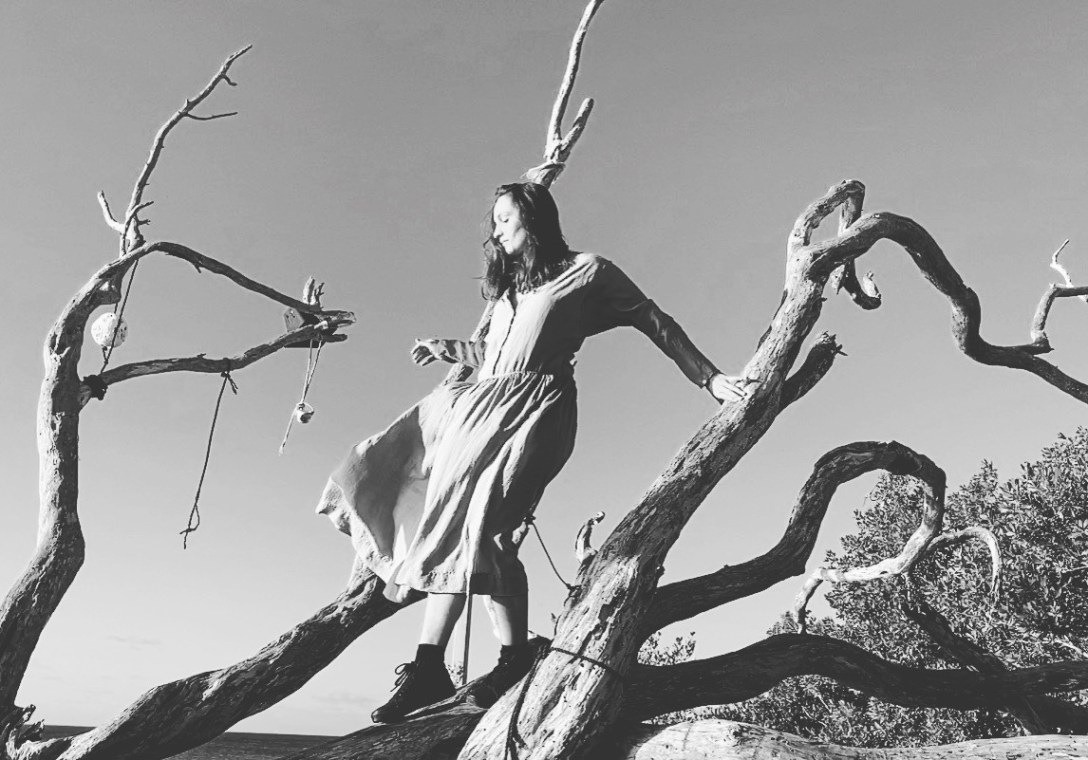
On Driftwood

This morning my grandma and I woke up in the darkness at 6am to shoot a music video.
We wouldn’t have done this, except we were walking along a remote beach last week, and came across this abandoned homestead made of driftwood. There once was a community of people living here, my grandma said: I used to see them when I walked my dog down here years ago. In place of the colorful tents and long-haired men that once nestled into the sand, only a driftwood castle remained. They built this massive, angular structure, the center of their village, the gathering place. They tied emblems to the ends of the bone-dry branches: old Nikes, beautiful glass bottles, buoys, and strips of colorful ribbon. They painted a few branches with vibrant blues, yellows, and pinks, penning all-seeing eyes and names of past lovers. They put up a plaque for someone named “Red” who died there in 2009. There were clear outlines of different rooms, like the Aztec ruins in New Mexico.
When we first came across the driftwood complex, I felt like I was in Peter Pan’s wonderland. The place had magic. I felt so inspired. I casually mentioned how great it would be to shoot a music video there, and my grandma said, why not? We should do it.
I don’t think many people can say that their grandma was the videographer for their music video. I’m feeling really blessed to be in this position. My grandma happens to be a really masterful photographer, so she’s accustomed to being behind the camera, and was really excited about collaborating on this project with me. And I’m accustomed to being in front of it – it’s part of my job as a professional musician. I especially love shooting music videos where I’m interacting with nature – I shot one on an iPhone camera last fall, and made one with Lilac Milk last winter.
So this morning we drove out to the beach for sunrise and shot the first footage for the new music video for my song Meteor. In the castle on the sand.
 Siena Rose