
When I hit my limit, I often can’t believe how little I could handle. So the next time I push myself past my limit. And then my body puts me in my place and shuts down. Maybe eventually I’ll learn to trust my body every time.

When I hit my limit, I often can’t believe how little I could handle. So the next time I push myself past my limit. And then my body puts me in my place and shuts down. Maybe eventually I’ll learn to trust my body every time.

Subscribe to receive an email each time I write a new post!
For the second time today, I’ve left the pot of water boiling on the stove. It sat there, bubbling away, until the last drop of water sizzled out, the kitchen filled up with a concerning hot-chemical smell, and the inside of the pot turned a sickly white color. I discovered this scene when I casually ambled back into the kitchen, totally unaware that anything was amiss…until I sniffed the air and caught sight of the pot.
Aaaand cue the shame and amusement. Ashamed because I know it’s dangerous to leave the stove on, and I’ve lost count of how many times I’ve forgotten to turn it off this week. Amused because it’s pretty hilarious to forget something so simple. Turns out everything is gonna be okay, because my 82 year-old grandma is teaching me how to not forget.
Apparently electric stoves can cause electrical fires, which you can’t put out with water. I did not know this before sitting down to write this, so yeah, I’m glad I know now. I guess you’re supposed to use baking soda. Who would’ve known. Side note: I am absolutely floored by the number of uses baking soda has. Almost every time I ask Google how to do some daily activity, the answer is “use baking soda.” Get a grease stain out of a shirt? Throw baking soda on it. Cat pee in the carpet smelling up your hallway? Shake some baking soda on that shit. Rusty pan? Baking soda. Gunky sink? Baking soda. Clogged garbage disposal? Make a volcano by dumping baking soda and vinegar in there! (This is not even a joke – I actually looked this up once, tried it, and it worked). Pro tip.
Anyways.
So I keep leaving pots on the stove until they boil out. The irony of this is that I’m living with my grandmother, who does not leave pots boiling on the stove, and who is dealing with the lasting effects of a stroke. She is fascinated with the ways her mind has changed in old age: she mixes up opposite concepts (lemons with limes, hot with cold, dark with light) and sometimes will do the thing opposite to what she wanted to do. She says that since our memory of binary concepts lives in the same part of our brain, it’s difficult for her to separate them. It’s like you’re reaching into a single dark cupboard, feeling around for two identical cups. They might be different colors, but they feel exactly the same. At least that’s how I imagine it might feel like.
She also talks about how it’s often difficult to recall words (I imagine this like trying to draw water out of a deep well full of lily pads and cattails with a small bucket, but she’s the only one who knows what it’s actually like) and how her short-term memory is less powerful than it used to be, and more selective.
So just to recap: who is the one leaving pots on the stove? It’s me. Me, the 25-year-old whose frontal lobe JUUUUST BARELY firmed up into its full-fledged adult form. I have a newly-minted brain. So what’s going on here? I have no idea, but I find it intriguing, so here are some musings on memory.
Memory is a fickle thing. It turns out that most of us remember in stories, not in concrete accounts of exactly what happened. Each time we recall something, dredging it up from our well of past experiences, we handle it, shape it, and share it. We mix up the memory while fitting it into our current belief systems and habits. When we put it back, it’s more of a story than before. It’s a reflection of our identity.
In The Body Keeps the Score, Bessel Van Der Kolk invites us even deeper into the confusing world of memories and recollection. He describes a study in which veterans were interviewed directly after returning home from the Vietnam war, and then again years later, when they were in their 80s. In their old age, the healthy vets gave very different descriptions of the war than when they were young and fresh out of battle. Over the years, they had moulded their memories to fit nicely into their current identity. They had a core self, and their recollections had become fully transformed by it.
Conversely, the vets who developed Post-Traumatic Stress Disorder gave THE EXACT SAME descriptions of the war when they were 80 years old as when they were 20. They told the same story. Their memories (of the traumatic event) were frozen in time. Here’s the crucial difference between the vets with PTSD and the vets without: for vets with PTSD, memory was not transformed by identity. In fact, the memory itself, stuck forever in its original form, becomes a permanent part of their identity. Not the other way around.
People with PTSD don’t just have trouble integrating our memories with our current core self. We also have trouble with basic memory functions. Specifically, PTSD affects the first stage of memory function: initially acquiring and learning information. This is very crucial when we’re trying to remember something in the short-term. Like returning to the stove a few minutes after putting the water on to boil to pour our tea, for example.
All this memory gobbledegook may have something to do with why my grandma is the expert on memory in this household (besides the fact that she has a PhD in psychology from Columbia). She’s had many more years of practice not remembering things. She knows the secrets. The solution? Don’t use your memory at all. Just use your senses. Sensory memory comes before short-term memory on the path to storing information in our brains. Use a physical habit that takes the place of needing to remember. Stay in the room. Don’t let yourself leave while the pot is on the stove. Keep it within sight. And voila! No need to remember a thing.
Choose an amount
Or enter a custom amount
Thank you so very much. Your generosity and support really make a difference.
Thank you so very much. Your generosity and support really make a difference.
Thank you so very much. Your generosity and support really make a difference.
DonateDonate monthlyDonate yearly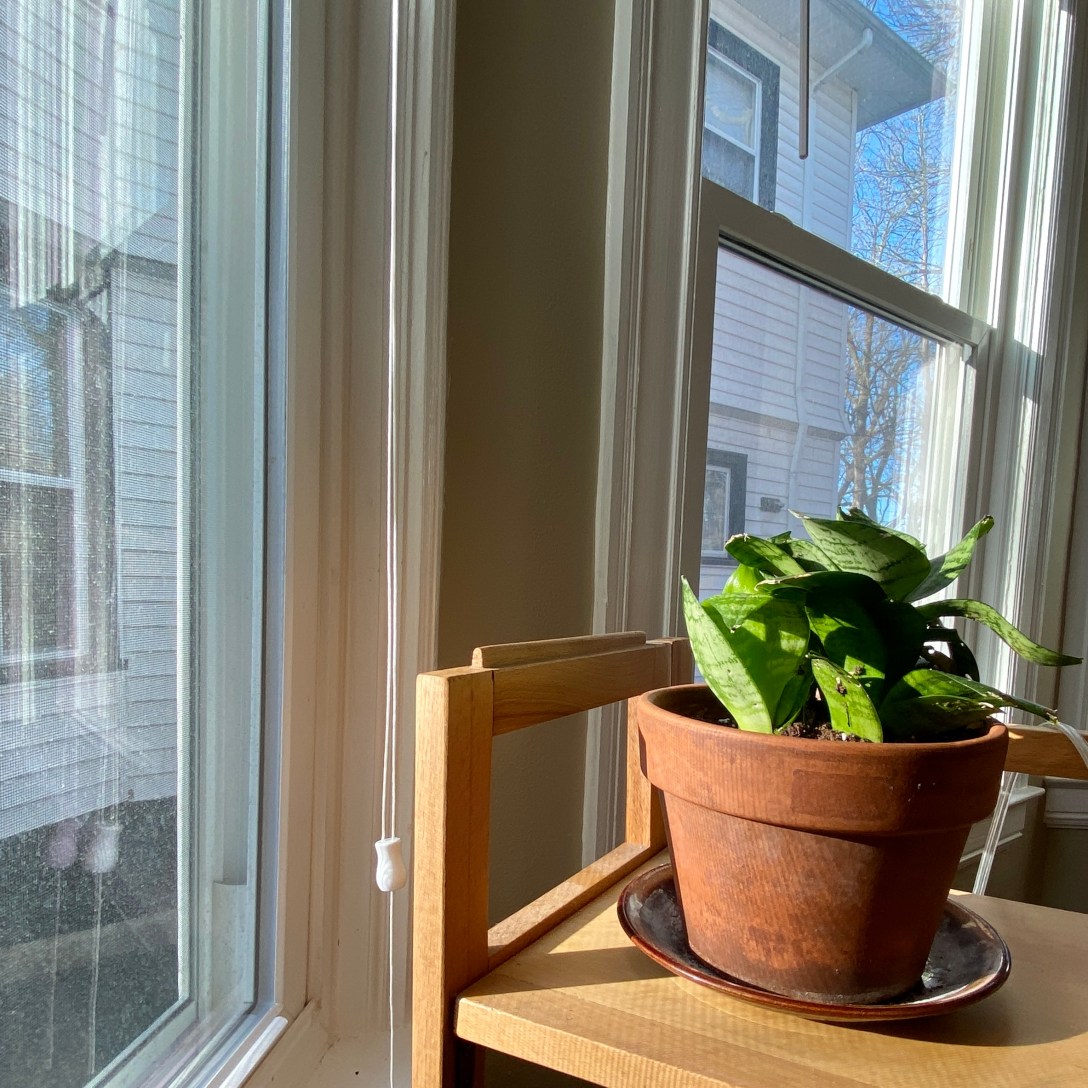
I’ve been writing about some heavy shit recently, so tonight I want to talk about something more joyful: house plants. I’m obsessed. I feel like a lot of people got super into house plants over the past two years. We were stuck inside in quarantine for so much of 2020: forced to face our own inner worlds for months at a time, as well as our dreary apartments that we hadn’t quite gotten around to fixing up. We needed relief.
We needed something to care about, other than the global pandemic and the presidential election. We needed something that was our own, something we didn’t have to do in tandem with our housemates, who were ALWAYS AROUND (why were they always popping up in the room we wanted to be alone in?). We needed some friggen house plants.
I harbor real love for my plants. They’re like little babies, except they don’t wake up screaming in the middle of the night, or suck up all of your hard-earned cash as soon as you put it in the bank. They’re the perfect progeny: demanding just enough attention that you feel accomplished, even benevolent, for nurturing them, but not so needy that you feel overwhelmed and desperate for a break. Plus, I’ve been learning so much. Now I know that you can propagate almost any plant, as long as you have time and a lot of patience.
When I graduated from the University of Rochester in 2019, a close friend gave me his Pothos babies that he had been rooting in plastic water-bottles. I planted them in hanging baskets that were WAY too big for their tiny little roots. Not knowing that at the time, I just patiently waited for them to grow, keeping them in a sunny spot on our porch in the summer, and by a window upstairs in the winter. Now, they’re huge, healthy vines that cascade down into my home studio.
Plants are amazing for sharing love, and passing down traditions. I’ve propagated more Pothos babies from those original plants than I can count, and gifted a precious Pothos baby to a close friend. I also gave a Pilea pup to my mom to bring back to her farmhouse in Vermont. For awhile, she sent me daily updates on how the plant was doing. It was so cute. My grandmother has a 30-year old jade tree, with a thick trunk, that I absolutely love. When I was there last, I collected a jade pup from this primordial mother, a small, dark-green baby that’s now growing happily on my windowsill in Rochester.
It feels really lovely to know that the plants you’re growing can actually make other people’s lives brighter, not just your own. Sharing plants is a huge reason I love growing them.
For more propagating madness, I picked up a couple of Arrowhead cuttings from my neighbors, which I rooted in water. Most of them didn’t make it, since I was pretty inexperienced and had no idea how much to water anything, but one plant survived. I’ve had that little one for over a year now. Once, she was down to a single leaf, and I valiantly nursed her back to health. Now, she’s healthy and happy with lots of leaves, sitting on my piano in front of a south-facing window.
I find it hilarious, and touching, that word is getting out that I’m obsessed with plants. One friend moved away from Rochester for a year-long graduate program in Spain and left her house plants with me to “babysit.” I happily welcomed her Cat Palm and Zebra succulent into my growing indoor jungle. It’s a bit more pressure taking care of someone else’s plants, but I like the challenge.
My mom, seeing how excited I was about all of my house plants, brought me a Prayer plant as a gift. She said it was my grandmother’s favorite plant. It made me feel more connected to my family. Now, whenever I water my Prayer plant or trim yellowing leaves, I feel like I’m with my mother and grandmother.
I’ll tell one last plant story, and then I have to go to sleep. My dad, who is a real estate agent in Vermont, was showing a house that had been abandoned for a few years. It belonged to an old couple, both deceased now, and the family was finally selling it. Sitting on a small stool by the front door, forgotten in its terra cotta pot, was an ancient aloe plant struggling to survive. This thing was huge. It mostly consisted of dry, yellow stalks. Just the tips of the plant were green, juicy aloe leaves. He saw it, and immediately knew what he had to do. He brought it to Rochester as a gift for me.
I was ecstatic. I can’t even tell you how excited I was to have this nearly-dead aloe plant. I immediately went to work digging out individual roots, cutting off excess dried leaves, replanting the big old plants in their own individual pots, potting the healthier pups, and composting the parts that were too far gone to save. I now have an entire guest room FULL of aloe plants. Some are large, some are tiny, some have long yellow stalks, and I love them all. A lot of them have started growing pups, and I can’t wait until I have pots overflowing with green, healthy aloe. I have no idea what I’m going to do with all of it, but I don’t really care.
Now that I’m in Florida, I genuinely miss all my plant babies. They bring me so much joy. When I’m feeling really anxious, angry, or lonely, watering and pruning my plants is one of the only things that can bring me out of my funk. Or at least make me feel less alone.
Here are the house plants I’m taking care of right now:
-Laurentii Snake plant
-Whale’s Fin Snake plant
-Golden Pothos
-Jade plant
-Vittatum Spider plant
-Pilea (Chinese money plant)
-Cat Palm
-Sword Fern
-Dragon Tree
-Zebra plant
-Elephant Bush
-Alice evans succulent
-Arrowhead plant
-Peace plant
-Aloe Vera
–Succulent Bush Senecio
Here are the house plants I’ve managed to kill so far:
-Mexican Snow Ball
-Ruby peperomia
-Echeveria ‘Perle von Nurnberg’
-Lavender (I’ve actually killed two different lavender plants….)
-English Ivy
-Strawberry Begonia
-probably more I’m forgetting
I can’t start at the very beginning of this story, because that would overcrowd the format I’m working with – the blog post. Instead, I’m going to start in the middle, and it won’t have a proper ending. Make of it what you will.
I have carried my trauma with me, in my body, belief-system, and behaviors, since I was 6 years old and was molested for the first time. What is the actual cost of that trauma? What is the cost of healing? Spoiler alert: it’s $94,090. You’ll see how I arrived at that number soon.
As a high school sophomore, I was already resigned to give my power over to other people. That’s how I learned to be in relationship with someone else. When I was 6, a family friend molested me. When I was 14, a boy I was romantically involved with sexually assaulted me. These were my first sexual experiences. I assumed that this was how it worked: I was trained not to focus on myself, but rather to focus all my energy on somebody else’s desire. I knew that their will would prevail no matter what.
So it’s not surprising that, as a 16-year old sophomore, convinced I had no power in a relationship, I got romantically involved with an older boy who abused me. The boy was in college already, while I was still chugging through high school, so the power-dynamic was already skewed in his favor. Out of the nine behaviors Rainn.org lists as warning signs of intimate partner abuse, this person consistently practiced six of them.
Finally, at age 19, I entered into my worst, and last, abusive relationship. This person was physically violent. He tore apart my self-confidence every day, until I eventually didn’t believe my own sense of reality and couldn’t escape.
Until recently, I carried these abuses in my body and belief-system as “normal” and “okay.” Until recently, I blamed myself for having intense reactions to the abuse. I was too flaky, too emotional, too sad, too dark, too intense, too obsessive, too empathetic, too involved, and too messy.
What has it cost to face this trauma, and start healing from it?
–$12,000 (therapy 2019-2021, 50 weeks/yr, $80/session)
–$5,000 (therapy 2018, 50 weeks/yr, $100/session)
–$4,000 (therapy 2013, 50 weeks/yr, $80/session)
–$1,050 (psychiatry, $175/session)
–$1,000 (dance & somatic classes, $5-$20/class)
–$640 (body work sessions, $80/session)
–$200 (gas for travel to and from appointments)
–$150 (Qi Gong classes 2016, 10 weeks, $15/class)
–$50 (medication)
So that’s $24,090 in expenses. Now let’s examine how trauma/healing work has affected my earning power in the workforce over the past 5 years.
–$25,000 forced rest year: (due to untreated clinical depression, anxiety, and PTSD, I needed to take the entire year to rest/heal/process from 2016-2017. For that year, I was unable to work towards a BA degree, work at a paying job for more than 15 hours a week, or network in my field.)
–$45,000 reduced earning power since graduating with a BA in 2019 ($15,000 a year, due to PTSD symptoms – I’ll write more about this later)
That’s $70,000 of lost income due to the effects of my trauma.
If I add that loss to my expenses, the total cost of trauma and healing for me and my family has been $94,090. That’s a shit-ton of money.
These costs are STILL ADDING UP. I’m still healing. I’m still not able to work as many hours per day, or with the same focus, as I could before developing PTSD. That’s income I’m missing out on every single day. I’m still putting all I’ve got into trying to live the way I want to live. Trying to grow out of this trauma, instead of letting it slowly destroy me. And I haven’t even STARTED to discuss how privileged I am that I have a family who has been willing to financially support my healing process.
Healing from trauma is expensive. I didn’t have a choice in whether or not to be traumatized. But unlike cancer, or the flu, which occur without human consent, a person made a choice to abuse me. Multiple people, actually. Those people made decisions, and I am paying for those decisions.
I’m just putting it out there: maybe there’s a way that the people who inflict trauma can pay, financially, for the healing process. Any ideas?
 Siena Rose