
My job is to live in the liminal spaces.
My job is to recognize the unique core of every person I meet.
My job is to merge life and death until they are indistinguishable.
My job is to lie down in city graveyards.
My job is to stare at the trees dancing in the late August wind.
My job is to close my eyes and recognize the infinite grasping and gulping for air.
My job is to watch the blades of grass caress the cut stone of the graves, to absorb the desperation and intention with which humans desire permanence.
My job is to find people who will build me up and create a clear space for work and play.
My job is to stay clear on what my job is.
My job is to find ways to do my job.
My job is to remain open to new channels.
My job is to break myself open, again and again, trusting that I will always be whole, even as I fall apart.
My job is to expect nothing and everything all at once, forever.
My job is to be human and allow others to witness me being human.
My job is to create spaces for people to feel safe being human in concert with one another.
My job is to ask questions.
My job is to be part of nature.
My job is to gently unfold the blocks inside of me, inquiring into what might lie behind, underneath, and between them.
My job is to look at my hands in wonder.
My job is to use my hands to create music, writing, dance, thus communicating in the most direct way I know how.
My job is to feel the earth holding me.
My job is to discern discomfort from endangerment.
My job is to cherish the creative connections, friendships, and relationships I have been gifted with.
My job is to lead with honesty and compassion.
My job is to remain present with the stuff that feels ambiguous, confusing, murky, muddy, in between, and fuzzy.
My job is to translate the immediacy of life and death into art.
My job is to hold hope.
My job is to feel the seasons change.
My job is to let go of “shoulds” and find what feels good.
My job is to decorate Easter Eggs with tiny broken treasures I’ve slowly and intentionally collected over the years.
My job is to listen to the small voices, and report back.
My job is to commune with souls while “performing” (sharing, broadcasting, communicating) music and spoken word on stages, in living rooms, and in headphones.
My job is to turn towards the truth of being alive in the chaos.
My job is knowing myself well enough to know when something in my life is dying.
My job is to hold hands.
My job is to dance, sweaty and joyful, among people I love.
My job is to recognize the the sadness and hurt in others, and to hold space for it without becoming it myself.
My job is to lean into sensation if it’s pleasurable, and say no to sensation if it’s unwanted.
My job is to surrender to the mystery.
My job is to shout my humanness from the tallest hill where somebody and nobody can hear me.
My job is to follow the softness.
My job is to pull up my socks and keep going.
Tag: healing
we are always changing (the ocean)
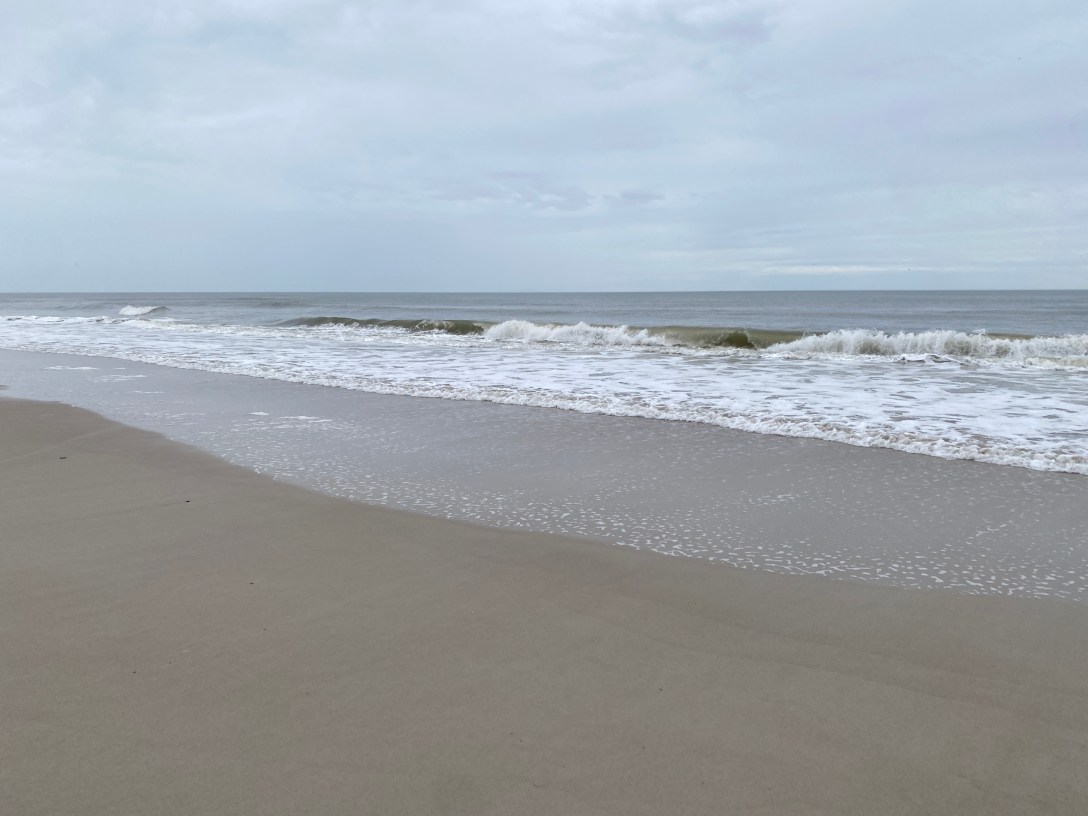
The ocean is always changing.
I’ve read that, in various forms and architectures, many times over the years. So many iterations of the same, ancient human knowledge, and yet I have never truly known, not really, until today. I don’t think I fully understand anything until I’ve experienced it, viscerally, without analysis.
The thing about the ocean is that the waves are always there, the water always has a relatively consistent chemical makeup, and the sand changes so imperceptibly that it appears to remain the same for thousands of years.
And yet.
Every single time I walk to the beach and stand facing the horizon, the ocean is new. Completely, astonishingly new. There will never be another day, and never has been, when the ocean has been this particular shade of purple as the sun rests behind charcoal grey storm clouds, or this pale, shimmering blue like the inside of an oyster shell, or this impossible frothy thing, awash with orange as the last daylight slips beyond the horizon.
She is untamable.
The crests of her waves shine with bright pleasure one day, and the next she is throwing herself against the sand in grief. Just when I think I know her, can pin her down, find a pattern, she is off again. Using some other palette, some other context. Of course, we hear that the ocean is wild, in “the literature” (to be read with a posh British accent and a sardonic smile). She is a wild, mystical beast, you cannot tame her.
I plant my feet in the sand and gaze out at the water, open to whatever she has to say. Needing a guide. Needing connection. Hoping that her magnetic dance can draw me out of the cramped body I reside in. I have collected so many barriers that it often feels like I’m wandering a maze of my own design. Each wall has helped me, protected me, in moments of extreme distress, but now I need to let some go. I need a dissolving.
And she is here. She is as ephemeral as she is powerful. Her body never stops changing. Her shape never stops shifting. Her context never stops evolving, each part responding to another part, a tapestry of overlapping elements and systems.
I face the ocean and ask her the one question I am always asking.
A vision comes back to me. It is 2018. Tara Brach is guiding me through a meditation. I bring my most heavy, unmanageable problem to the feet of my most wise self. I ask for her guidance. I surrender to presence, breathing in and out. By way of an answer, I receive an image, clear and colorful. I am standing on a grassy riverbed. I am full of something. Is it hope? Is it peace? Is it fierceness? It is something close to equanimity. My bare feet rest firmly in the grass, arms relaxed by my side, as I look slightly up and to my left. I can see my back and the slender, half-moon shape of my profile, and my hands, like dancers by my sides. I see the river, slow, dark, wide. I see all of this from ten paces behind myself, watching the energetic breeze lift my long, brown hair, my fingertips sway slightly with the movement of the wind. I am alone, and yet, I am not alone in the slightest.
I think of this now as I stand before the ocean. Is this an answer? Or simply a continuation of the question. Does having an answer matter? The cycle continues. Just as the cycle of the tide, of each wave, even, has no ending, so does this question I am asking. This need. There will never be a question and answer that satisfies the longing, just as there will never be a moment when the ocean is exactly the same as she was before.
The ocean is always changing. She is wild, untamable, a beast, a mystery. Is she so different from us, then? Is she so separate? One day I am dancing down the sidewalk in the dark, and the next I am wishing I were gone. The parade, no, the circus, of emotions, saturates my body almost every moment of every day. I am elated, now I am scared, now I am heavy with regret. Nothing is constant. Just like her.
And I smile, then, because I realize that the ocean is teaching me. And the question will be asked, and the need will be presented, over and over, and true power will be created by the cyclical movement of it all. I realize that this power, the kind that I had in my vision, comes from being a witness to it all. I realize that it is not a dissolving I need, but an opening. I realize that my feet are holding up my body, pressing firmly into the earth, and that I am looking up and slightly to my left. And I am here.
Ocean
I am in love with Ocean
lifting her thousands of white hats
in the chop of the storm,
or lying smooth and blue, the
loveliest bed in the world.
In the personal life, there is
always grief more than enough,
a heart-load for each of us
on the dusty road. I suppose
there is a reason for this, so I will be
patient, acquiescent. But I will live
nowhere except here, by Ocean, trusting
equally in all the blast and welcome
of her sorrowless, salt self.
-Mary Oliver, from Red Bird
the mess that remains
We are racing through a living room, on the north side of the house, unsure if this is a game or a real life-or-death situation. My sister has a box in her hands, and she is running from me. The box is plastic, with tiny compartments, each filled with a different type of colorful bead, and her hands are small. My hands are clenched into fists.
Anger billows up out of my armpits, my shoulders, my knees. I sprint faster, finally gaining on my younger sister, Maya, who, in a flash of inspiration, runs up the stairs.
NO. The hot pressure sticks to my ribs, threatening to detonate. A word blooms in my stomach, burrows up through my esophagus, presses against my tongue, digs deep into the crevices of my jaw. I’ve said this word so many times before, in thousands of ways. Sometimes it comes out soft, gentle, imploring, but other times it comes out fighting, harsh, urgent.
I see what is happening in slow motion. That’s not even the right way to describe it. It’s not slow motion. It’s focus. Detached focus. I see what is happening with a focus so clear, it’s as if I am a monk meditating in a Himalayan temple. I know I am about to scream. I know that it is going to be so loud that it will hurt my throat to do it. I know my sister will not be happy about it. I know I will do it anyway.
“MAYAAAAAAAAAAAAA!” I bellow.
Everything stops. She comes to an abrupt halt and looks back at me, full of genuine innocence and hurt. I stand breathing heavily. The anger dissipates. She comes down the stairs. She is deflated, I am deflated, the whole expansive moment is forever deflated.
All I know now is that my sister is sad.
And then it happens. I don’t want her sadness to be my fault. The blame is too much, the guilt overwhelming. I make a pact with myself, then and there, in the pregnant pause between the yelling and her response. I will never scream at my sister again. No matter how angry I get, how much pressure builds up in my body, I won’t let it escape again.
Ever.
I kept this pact for years, almost perfectly, not just with my sister, but with everyone else in my life.
Until the Ritz cracker incident.
The next time I let the word “no” escape from the surface of my skin was in a middle school cafeteria. I sat with my stomach pressed up against a round, dark brown, plastic lunch table. My legs fidgeted under the seat as I manically devoured a bag of Ritz crackers, butter and crumbs spreading thick over my fingertips and tongue. We were debating over which deodorant worked best to keep our sixth-grade sweaty armpits dry. You interrupted our discussion with a question: can I have a cracker? you asked.
I froze. I looked at my crackers. I looked at you.
I was still hungry, and realized suddenly that I didn’t want to give up a single one. Maybe I wanted to eat the rest after school, all by myself. Maybe I wanted to finish the entire roll, right now. I didn’t know exactly what I wanted to do with them, but it suddenly dawned on me that I could tell you no. That your request did not demand immediate obligation on my part.
I said no.
You were surprised, but surrendered.
Truly, before this moment, I had not considered the possibility that I could refuse a request. In my reality, a request from someone was like water. It filled up the space between us, swiftly and completely, flooding everything in its path. The space was immediately full, heavy and real, belonging solely to the requester. There was no room left for me to add anything of mine.
There was no room for my no.
Somewhere along the way, I decided that feeling guilt was more unpleasant than being violated. Somewhere along the way, I decided it was far better to disappoint myself than to disappoint somebody else. I could stand to internalize my own pain. I just couldn’t stand internalizing theirs.
Allowing myself to fade into the background felt easier than experiencing guilt, which inevitably led to Shame. The belief that I was bad and wrong permeated my body. It crushed me. By permitting the violation instead of the “no,” I successfully avoided Shame.
In my mind, I was a tiny dot and the other, whoever the other happened to be, was a huge sun. My job, as the miniscule dot, was to relentlessly and passionately throw energy in the sun’s direction so they would not burn out. My job was to make sure they were always taken care of. In my mind, I had signed a contract at birth stipulating that, no matter what the cost, I existed to make sure their light never went out.
I heeded that contract to the letter. I was a good rule follower. I was “good.”
My fear of being seen as “bad” always trumped the fear of hurting, or even of dying. And it certainly outweighed the fear of feeling uncomfortable in my own body. I avoided guilt at all costs. If it meant wounding myself in the process, so be it. Whatever it took, I avoided guilt.
In this way, I avoided shame.
In this way, I avoided learning how to listen to myself.
Until the Ritz cracker. This was a big deal. This was in direct violation of the contract I believed I was in with the Universe.
After I said my no, you looked taken aback. You asked, why won’t you give me one? I want all of them, I mumbled. You leaned your head back and raised your eyebrows in performative incredulity, making sure all of our friends saw how shocked and offended you were. Then, as suddenly as it had started, the scene was over. I kept my Ritz crackers. We were still friends. Everything seemed to be okay.
Except there, in the center of my chest, there was a sensation blooming. My chest was collapsing, as if a gigantic mudslide coursed down between my ribs, pulling bones, muscle, debris down into the abyss, threatening to take the rest of my body with it. My throat tightened into the size of a tiny coffee stirring straw, and my head felt thick with tension.
There was a reason I religiously avoided disappointing people. Although I had just committed a revolution by saying no, I still had to deal with the mess of guilt and shame that remained in my body.
There was no way to escape. My body would never let me.
we are the subject, not the object
I was.
I wanted.
I came.
I remember.
I felt.
I wanted.
I needed.
I conducted.
I made.
I wanted.
I knew.
I lived.
I was afraid.
I was listening.
I wanted to be free.
I came across myself many times over.
I remembered.
I felt myself forgetting.
I wanted to be good.
I needed everything.
I conducted ceremonies.
I climbed up, even as I dreaded falling off.
I made myself jump.
I wanted wholeness.
I knew I would always be leaving a version of myself behind.
I lived anyway.
the people want more
Onstage, we feel everything we are not supposed to feel in real life. Onstage, we sigh and gyrate our hips, using love to manipulate. Onstage, our worst memories are applauded. Onstage, we are unmasked. The shit-show of humanity is on display, and the people want more.
breakfast
tiny hairs on the tomato stems are white in the morning light. basil leaves broad and satin, tilted towards the southern window. hot water poured over Earl Grey leaves, curled like seeds in a silver cradle. silky cow’s milk drops in, the whole fragrant mug waiting patiently on a table as the Bergamot and tannins infuse into the gently steaming mixture. peanut butter spread on store-bought english muffins (the homemade ones are long gone), melting into the doughy crags. tendrils of coffee-scented air waft across seedling tops, red armchair, rainbow beams of light from the crystal hanging in the window, laundry draped across the old metal rack, stacks of poetry books, cobwebs between the ceiling and the walls. breakfast has commenced.
absolute annihilation
I don’t want to write tonight – I am not inspired. I have gotten burnt out from trying to get better at too many different things at once. There’s music, writing, podcasting, teaching, gardening, making money, and building relationships. If I’m not the best at every one of them, somehow my body will implode in on itself while the ground turns into quicksand and I disappear in under a millisecond. Somehow I know this will happen, at a deep, reptilian level. So, to avoid absolute annihilation, I attempt to improve everything I do, at all times. That shit is not gonna work. Now I’m lying in bed, super sick, because my body couldn’t handle it all. I don’t know how to stop. I wish it didn’t take getting this sick to force myself to stop. What is this thing propelling me forward?
all this will be ruins
All this will be ruins someday. The earth re-membering herself, re-calling her own Name. All this will be ruins someday. The bright red METRO MATTRESS DISCOUNT SLEEP SUPERSTORE sign will crack and sink into the soft forgiveness of the mud. Every Grande styrofoam cup will slowly settle beneath the dirt, snap into pieces, become one with bulging roots and galaxies of mycelium. There will be no plastic left, only vivid tangles of roots. Swelling. Sighing. It will all be ruins.
All this will be ruins someday. Every desperate, pavement-sodden parking lot will cry out in relief as burbling streams find their way through the concrete, saplings shove themselves up between tiny crevices, and grass sprouts up, along the perimeter, now in the middle, now in every possible direction. It will all be ruins.
All this will be ruins someday. Ruin, from the Latin word “ruere,” meaning “to fall violently,” turning into an Old English word meaning “act of giving way” and the Italian word “rovina,” meaning “to knock down, tear out, or dig up.” Ruins. What a relief to release the burden of progress and productivity. It will all be ruins.
All this will be ruins someday. A re-in-statement of the natural order of things. A letting-go of the chokehold we have on the world, this dangerous and exhausting myth of control. A digging up of all that we have imposed on Her. All this will be ruins someday.
May that day come sooner, rather than later.
what am I learning to love?
Love. How this word eats away at us. How we long for the definition, some clarity, something to land in. Is it too cruel to say that landing in love is a myth? Learning to love, on the other hand, is the entirety of it. So, as I answer this question, I will be contemplating love in its entirety, in all the dark, damp layers of it. I’m learning to love the routine of folding laundry slowly over the course of the weekend. I’m learning to love the feeling of grief when another tiny seedling dies for no apparent reason. I’m learning to love the click of cheap shades against the windowsill, as the spring wind laps at the side of our house. I’m learning to love the revision process for each blog post I write for all the small business owners looking for SEO bolstering. I’m learning to love the feeling of collapsing into bed after a day of frayed nerves and lingering hugs. I’m learning to love chopping vegetables for strange stews while my fiancé practices snare drum etudes in the studio. I’m learning to love growing herbs on the windowsill. I’m learning to love saying hi to people on their porches as I walk past. I’m learning to love being financially stable for the first time in my independent adult life. I’m learning to love my fiancé’s stubbornness in the face of change. I’m learning to love my self-judgement. I’m learning to love the possibility of rest and rejuvenation. I’m learning to love the rain again. I’m learning to love uncertainty, of not knowing, of not fully understanding. I’m learning to love those moments when I cannot hold myself up for crying so much. I’m learning to love my integrity. I’m learning to love saying no to things I cannot or do not want to take on. I’m learning to love the place where “humanness” and “nature” touch noses and swirl into one another.
how tempting it is
How tempting it is to build a monument to our pain, a towering monolith of trauma, a permanent tattoo of our losses. “Look,” we call, “look at how you have ravaged my soul. Look at my body in tatters.” How we forget that we are already building the most powerful monument: the story of how we have gathered ourselves up again, yawning piece by yawning piece, warming our bodies around a new, infallible belief in ourselves, expanding as our disfigured mouths grow pink and taut with healing. “We are here,” we call, “we are here, whether you see us or not.”
 Siena Rose