
What if we were taught how to love, in the same way we were taught to not look at the sun?
Category: Ordinary Days
what would it be like
As he and I watched the sunset on my last evening in North Carolina, he said, “I’m so jealous. I’d be riding a wind current up there, like a hawk, not even flapping my wings.” I stared out at the sky, at the birds, black swatches against the pinkening horizon. I was reminded of The Once and Future King, when Merlin teaches The Wart by allowing him to inhabit animal bodies: ants, geese, fish.
What would it be like to have the strength of imagination, or memory, to know what that would feel like, deep in the marrow of your bones?
like planets
there’s blood
between the cracks in stone
someone has left it there
tiny, congealing spheres
like planets
whole
and undisturbed
perhaps the blade was too new
or the hand gone rogue in a too-small kitchen
or, perhaps, in some frantic war
the red settled into piles
of chalky rubble
in between the stones
in obvious relief
bright and tired and exposed to the sun
grieving or relieved
Below my eastern window
A yellow leaf floats to the ground
I am not sure if I am grieving
Or relieved.
Here is a chance to slow down,
Maybe even to reflect,
To practice letting go of the enormous effort
It takes to sustain summer’s brilliant theater.
Here is my sadness,
Here is a death
And the possibility of being reborn.
always with you
it takes and takes and takes
grief
by the fistful
grabbing handfuls of stomach,
liver, lungs
it is enraged beyond telling
that I will not be moved
that my body remains
upright
unbroken, and mine
everything inside is crumbling
and here I am
lifting the corners of my mouth
waking in the morning
always with you
and always without you
a simple question
why is the sun red?
is it tired?
concealed?
angry?
is it dying?
Manifesto
My job is to live in the liminal spaces.
My job is to recognize the unique core of every person I meet.
My job is to merge life and death until they are indistinguishable.
My job is to lie down in city graveyards.
My job is to stare at the trees dancing in the late August wind.
My job is to close my eyes and recognize the infinite grasping and gulping for air.
My job is to watch the blades of grass caress the cut stone of the graves, to absorb the desperation and intention with which humans desire permanence.
My job is to find people who will build me up and create a clear space for work and play.
My job is to stay clear on what my job is.
My job is to find ways to do my job.
My job is to remain open to new channels.
My job is to break myself open, again and again, trusting that I will always be whole, even as I fall apart.
My job is to expect nothing and everything all at once, forever.
My job is to be human and allow others to witness me being human.
My job is to create spaces for people to feel safe being human in concert with one another.
My job is to ask questions.
My job is to be part of nature.
My job is to gently unfold the blocks inside of me, inquiring into what might lie behind, underneath, and between them.
My job is to look at my hands in wonder.
My job is to use my hands to create music, writing, dance, thus communicating in the most direct way I know how.
My job is to feel the earth holding me.
My job is to discern discomfort from endangerment.
My job is to cherish the creative connections, friendships, and relationships I have been gifted with.
My job is to lead with honesty and compassion.
My job is to remain present with the stuff that feels ambiguous, confusing, murky, muddy, in between, and fuzzy.
My job is to translate the immediacy of life and death into art.
My job is to hold hope.
My job is to feel the seasons change.
My job is to let go of “shoulds” and find what feels good.
My job is to decorate Easter Eggs with tiny broken treasures I’ve slowly and intentionally collected over the years.
My job is to listen to the small voices, and report back.
My job is to commune with souls while “performing” (sharing, broadcasting, communicating) music and spoken word on stages, in living rooms, and in headphones.
My job is to turn towards the truth of being alive in the chaos.
My job is knowing myself well enough to know when something in my life is dying.
My job is to hold hands.
My job is to dance, sweaty and joyful, among people I love.
My job is to recognize the the sadness and hurt in others, and to hold space for it without becoming it myself.
My job is to lean into sensation if it’s pleasurable, and say no to sensation if it’s unwanted.
My job is to surrender to the mystery.
My job is to shout my humanness from the tallest hill where somebody and nobody can hear me.
My job is to follow the softness.
My job is to pull up my socks and keep going.
we are always changing (the ocean)
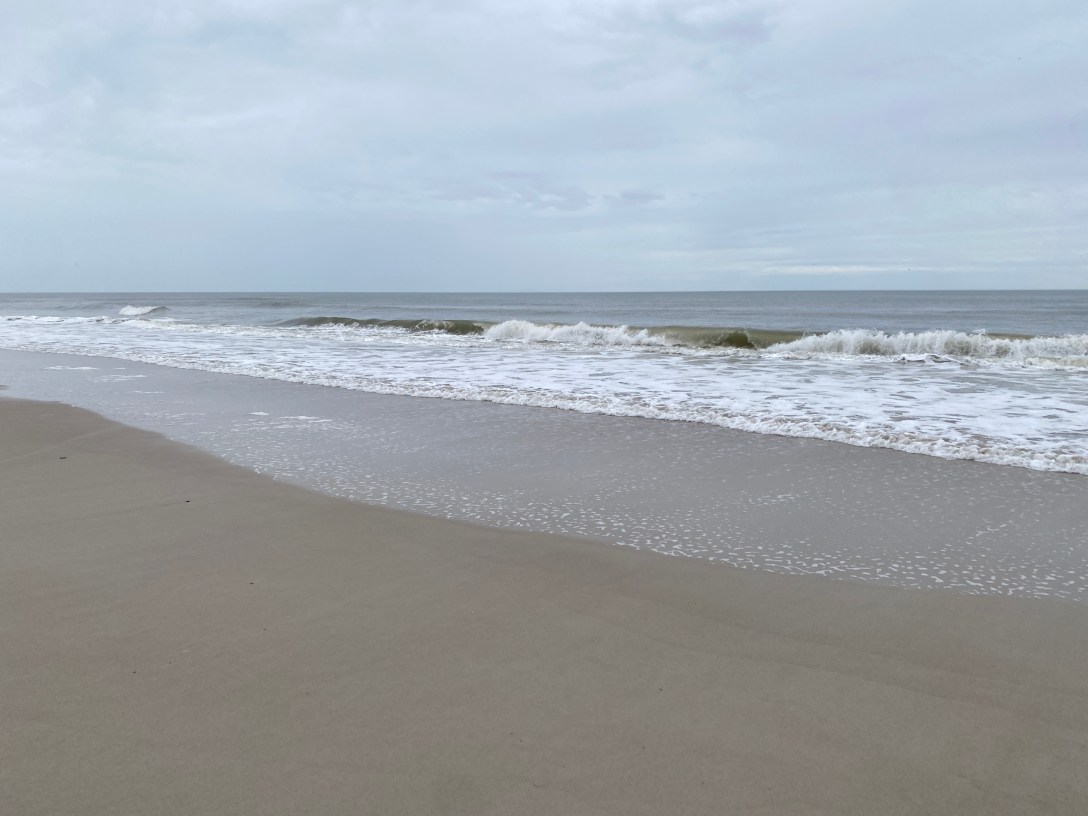
The ocean is always changing.
I’ve read that, in various forms and architectures, many times over the years. So many iterations of the same, ancient human knowledge, and yet I have never truly known, not really, until today. I don’t think I fully understand anything until I’ve experienced it, viscerally, without analysis.
The thing about the ocean is that the waves are always there, the water always has a relatively consistent chemical makeup, and the sand changes so imperceptibly that it appears to remain the same for thousands of years.
And yet.
Every single time I walk to the beach and stand facing the horizon, the ocean is new. Completely, astonishingly new. There will never be another day, and never has been, when the ocean has been this particular shade of purple as the sun rests behind charcoal grey storm clouds, or this pale, shimmering blue like the inside of an oyster shell, or this impossible frothy thing, awash with orange as the last daylight slips beyond the horizon.
She is untamable.
The crests of her waves shine with bright pleasure one day, and the next she is throwing herself against the sand in grief. Just when I think I know her, can pin her down, find a pattern, she is off again. Using some other palette, some other context. Of course, we hear that the ocean is wild, in “the literature” (to be read with a posh British accent and a sardonic smile). She is a wild, mystical beast, you cannot tame her.
I plant my feet in the sand and gaze out at the water, open to whatever she has to say. Needing a guide. Needing connection. Hoping that her magnetic dance can draw me out of the cramped body I reside in. I have collected so many barriers that it often feels like I’m wandering a maze of my own design. Each wall has helped me, protected me, in moments of extreme distress, but now I need to let some go. I need a dissolving.
And she is here. She is as ephemeral as she is powerful. Her body never stops changing. Her shape never stops shifting. Her context never stops evolving, each part responding to another part, a tapestry of overlapping elements and systems.
I face the ocean and ask her the one question I am always asking.
A vision comes back to me. It is 2018. Tara Brach is guiding me through a meditation. I bring my most heavy, unmanageable problem to the feet of my most wise self. I ask for her guidance. I surrender to presence, breathing in and out. By way of an answer, I receive an image, clear and colorful. I am standing on a grassy riverbed. I am full of something. Is it hope? Is it peace? Is it fierceness? It is something close to equanimity. My bare feet rest firmly in the grass, arms relaxed by my side, as I look slightly up and to my left. I can see my back and the slender, half-moon shape of my profile, and my hands, like dancers by my sides. I see the river, slow, dark, wide. I see all of this from ten paces behind myself, watching the energetic breeze lift my long, brown hair, my fingertips sway slightly with the movement of the wind. I am alone, and yet, I am not alone in the slightest.
I think of this now as I stand before the ocean. Is this an answer? Or simply a continuation of the question. Does having an answer matter? The cycle continues. Just as the cycle of the tide, of each wave, even, has no ending, so does this question I am asking. This need. There will never be a question and answer that satisfies the longing, just as there will never be a moment when the ocean is exactly the same as she was before.
The ocean is always changing. She is wild, untamable, a beast, a mystery. Is she so different from us, then? Is she so separate? One day I am dancing down the sidewalk in the dark, and the next I am wishing I were gone. The parade, no, the circus, of emotions, saturates my body almost every moment of every day. I am elated, now I am scared, now I am heavy with regret. Nothing is constant. Just like her.
And I smile, then, because I realize that the ocean is teaching me. And the question will be asked, and the need will be presented, over and over, and true power will be created by the cyclical movement of it all. I realize that this power, the kind that I had in my vision, comes from being a witness to it all. I realize that it is not a dissolving I need, but an opening. I realize that my feet are holding up my body, pressing firmly into the earth, and that I am looking up and slightly to my left. And I am here.
Ocean
I am in love with Ocean
lifting her thousands of white hats
in the chop of the storm,
or lying smooth and blue, the
loveliest bed in the world.
In the personal life, there is
always grief more than enough,
a heart-load for each of us
on the dusty road. I suppose
there is a reason for this, so I will be
patient, acquiescent. But I will live
nowhere except here, by Ocean, trusting
equally in all the blast and welcome
of her sorrowless, salt self.
-Mary Oliver, from Red Bird
the mess that remains
We are racing through a living room, on the north side of the house, unsure if this is a game or a real life-or-death situation. My sister has a box in her hands, and she is running from me. The box is plastic, with tiny compartments, each filled with a different type of colorful bead, and her hands are small. My hands are clenched into fists.
Anger billows up out of my armpits, my shoulders, my knees. I sprint faster, finally gaining on my younger sister, Maya, who, in a flash of inspiration, runs up the stairs.
NO. The hot pressure sticks to my ribs, threatening to detonate. A word blooms in my stomach, burrows up through my esophagus, presses against my tongue, digs deep into the crevices of my jaw. I’ve said this word so many times before, in thousands of ways. Sometimes it comes out soft, gentle, imploring, but other times it comes out fighting, harsh, urgent.
I see what is happening in slow motion. That’s not even the right way to describe it. It’s not slow motion. It’s focus. Detached focus. I see what is happening with a focus so clear, it’s as if I am a monk meditating in a Himalayan temple. I know I am about to scream. I know that it is going to be so loud that it will hurt my throat to do it. I know my sister will not be happy about it. I know I will do it anyway.
“MAYAAAAAAAAAAAAA!” I bellow.
Everything stops. She comes to an abrupt halt and looks back at me, full of genuine innocence and hurt. I stand breathing heavily. The anger dissipates. She comes down the stairs. She is deflated, I am deflated, the whole expansive moment is forever deflated.
All I know now is that my sister is sad.
And then it happens. I don’t want her sadness to be my fault. The blame is too much, the guilt overwhelming. I make a pact with myself, then and there, in the pregnant pause between the yelling and her response. I will never scream at my sister again. No matter how angry I get, how much pressure builds up in my body, I won’t let it escape again.
Ever.
I kept this pact for years, almost perfectly, not just with my sister, but with everyone else in my life.
Until the Ritz cracker incident.
The next time I let the word “no” escape from the surface of my skin was in a middle school cafeteria. I sat with my stomach pressed up against a round, dark brown, plastic lunch table. My legs fidgeted under the seat as I manically devoured a bag of Ritz crackers, butter and crumbs spreading thick over my fingertips and tongue. We were debating over which deodorant worked best to keep our sixth-grade sweaty armpits dry. You interrupted our discussion with a question: can I have a cracker? you asked.
I froze. I looked at my crackers. I looked at you.
I was still hungry, and realized suddenly that I didn’t want to give up a single one. Maybe I wanted to eat the rest after school, all by myself. Maybe I wanted to finish the entire roll, right now. I didn’t know exactly what I wanted to do with them, but it suddenly dawned on me that I could tell you no. That your request did not demand immediate obligation on my part.
I said no.
You were surprised, but surrendered.
Truly, before this moment, I had not considered the possibility that I could refuse a request. In my reality, a request from someone was like water. It filled up the space between us, swiftly and completely, flooding everything in its path. The space was immediately full, heavy and real, belonging solely to the requester. There was no room left for me to add anything of mine.
There was no room for my no.
Somewhere along the way, I decided that feeling guilt was more unpleasant than being violated. Somewhere along the way, I decided it was far better to disappoint myself than to disappoint somebody else. I could stand to internalize my own pain. I just couldn’t stand internalizing theirs.
Allowing myself to fade into the background felt easier than experiencing guilt, which inevitably led to Shame. The belief that I was bad and wrong permeated my body. It crushed me. By permitting the violation instead of the “no,” I successfully avoided Shame.
In my mind, I was a tiny dot and the other, whoever the other happened to be, was a huge sun. My job, as the miniscule dot, was to relentlessly and passionately throw energy in the sun’s direction so they would not burn out. My job was to make sure they were always taken care of. In my mind, I had signed a contract at birth stipulating that, no matter what the cost, I existed to make sure their light never went out.
I heeded that contract to the letter. I was a good rule follower. I was “good.”
My fear of being seen as “bad” always trumped the fear of hurting, or even of dying. And it certainly outweighed the fear of feeling uncomfortable in my own body. I avoided guilt at all costs. If it meant wounding myself in the process, so be it. Whatever it took, I avoided guilt.
In this way, I avoided shame.
In this way, I avoided learning how to listen to myself.
Until the Ritz cracker. This was a big deal. This was in direct violation of the contract I believed I was in with the Universe.
After I said my no, you looked taken aback. You asked, why won’t you give me one? I want all of them, I mumbled. You leaned your head back and raised your eyebrows in performative incredulity, making sure all of our friends saw how shocked and offended you were. Then, as suddenly as it had started, the scene was over. I kept my Ritz crackers. We were still friends. Everything seemed to be okay.
Except there, in the center of my chest, there was a sensation blooming. My chest was collapsing, as if a gigantic mudslide coursed down between my ribs, pulling bones, muscle, debris down into the abyss, threatening to take the rest of my body with it. My throat tightened into the size of a tiny coffee stirring straw, and my head felt thick with tension.
There was a reason I religiously avoided disappointing people. Although I had just committed a revolution by saying no, I still had to deal with the mess of guilt and shame that remained in my body.
There was no way to escape. My body would never let me.
an exploration of being wrong
I stand close to the speakers, in a swaying crowd. There are five men standing on-stage, each behind a shiny instrument, spread out in a leisurely semicircle.
They are wearing old shirts and singing sad songs. They look nice but they’ve probably raped somebody. They probably don’t even know it. That’s how “nice” they are.
The lead singer leans in close to the mic and introduces a song. It is a letter to his mother. It starts sweetly. The guitar accompaniment gently rocks back and forth, weaving a lullaby for every member of the audience. He sings about putting his heart on the line and getting rejected, sings that his mother told him that “city women ain’t the same.” Nothing about the music implies that it is a violent song, or even a disturbing song. Nothing prepares me for what happens next.
Suddenly, he sings the stanza that turns my blood to ice:
“I wish I was home, ma,
where the blue grass is growin’
and the sweet country girls don’t complain.”
Where the girls don’t complain.
Where the girls don’t complain.
Where the girls don’t complain.
Where the girls don’t complain. Where the girls don’t complain. Where the girls don’t complain Where the girls don’t complain. Where the girls don’t complain. Where the girls don’t complain. Where the girls don’t complain. Where the girls don’t complain. Where the girls don’t complain Where the girls don’t complain. Where the girls don’t complain. Where the girls don’t complain. Where the girls don’t complain. Where the girls don’t complain. Where the girls don’t complain Where the girls don’t complain. Where the girls don’t complain. Where the girls don’t complain. Where the girls don’t complain. Where the girls don’t complain. Where the girls don’t complain Where the girls don’t complain. Where the girls don’t complain. Where the girls don’t complain. Where the girls don’t complain. Where the girls don’t complain. Where the girls don’t complain Where the girls don’t complain. Where the girls don’t complain. Where the girls don’t complain. Where the girls don’t complain. Where the girls don’t complain. Where the girls don’t complain Where the girls don’t complain. Where the girls don’t complain. Where the girls don’t complain. Where the girls don’t complain. Where the girls don’t complain. Where the girls don’t complain Where the girls don’t complain. Where the girls don’t complain. Where the girls don’t complain.
Where the girls don’t complain.
That line digs thousands of tiny sandspurs into my throat that stick and don’t let go. I freeze. I am trapped in the familiar “triggered” state that I’ve come to know so well after years of living with Post-Traumatic Stress Disorder.
My body is no longer at ease, no longer dancing to the beat, no longer swaying, even. I am completely still. I do not have a body anymore, or, at least, I wish I didn’t have to have one.
I was once a girl who didn’t complain. I was hurt by men who didn’t want me to complain. I was raped by men who didn’t want me to complain. I was sexually assaulted by men who didn’t want me to complain. I continue to be consistently harassed by men who don’t want me to complain.
As the song warbles on, every inch of my body tenses actively against the music, the words, the well-meaning men on-stage, the cheering crowd, the lights, the sounds. My jaw is clenched as tight as it goes, teeth grinding against each other, tongue stiff in my mouth. My groin is tingling in a highly disturbing way and my shoulders are full of horrible potential energy that has nowhere to go, stuck in flight but ready to fight if necessary.
In a typical PTSD triggered state, my body can no longer tell the difference between this concert and being physically violated. They are one and the same. I feel a body on top of me, inside me, forcefully inserted years ago on a night when I didn’t complain. I feel a hand reaching down into my underwear during a bedtime story. I feel the shadow of a man looming over my sleeping body, stroking himself into my face. It is all real to me. I am getting raped all over again. I am being assaulted all over again. Except this time the man is on-stage and I am in the audience. He still has all the power. They all still have the power. I am powerless.
In a crowd of thousands, I am fully and completely alone. I am fully and completely trapped in this body, this betrayal, this attack. Because it is, of course, an attack.
Why has nobody noticed? My mother and my sister and all of the women around me clap and smile at the end of the song. I do not clap. I remain frozen in my spot, hands balled up into white-knuckled fists at my sides.
“Where the blue grass is growin,’
and the sweet country girls don’t complain.”
What is wrong with a woman complaining? The problem is, a woman complaining has the potential to actually stop men from getting what they want. A woman complaining grants her agency, power, autonomy. Space. Desire.
It may be a single line, but a single line is vitally important, and can be used for good. No language is neutral. “We shall overcome.” “I love you.” “Yes, we can.” These are single lines.
Why should this man, this group of men, be exempt from taking good care of the world?
When he sings that line, I feel the crushing weight of not complaining. I feel the sick, sick trick of internalizing every ounce of discomfort so no man ever has to experience any of it.
I am terrified. I am disappointed. I am angry. I am so angry.
My hands close into tight, fierce fists as the huge crowd around me claps and cheers. They clap and cheer. They gushingly approve his blatant disregard for a woman’s right to exist, to push back, to complain, to be her own autonomous being. Nobody cares that this song was written for a woman, for a mother. Nobody cares that he wrote this specific line from his mother’s perspective, from his mother’s own mouth.
These men can stand on-stage with enough privilege to carelessly contribute to society’s oppression and subjugation of women. They can because we let them. Why is this group of men allowed to subject us to their wills, their whims, their carelessness? Why have groups of men always been allowed to subject us to their carelessness?
I never want to open my hands. I don’t want to be exposed to the air. Even that feels far too violating. The crowd is cheering on my rapist. I am surrounded by enemies. I am my own enemy. I am trapped and there is no escape.
Hours after the concert, I am still frozen, throat tight, jaw clenched, torso braced against the world, against my mother’s hug, against the air, against my existence. On the walk back to the car, I gaze over the edge of a tall bridge and imagine myself throwing myself over the railing, intentional and final. How would I fall on the concrete below? Would I die or would I simply break my legs? I long to do it. I catch myself imagining suicide and feel ashamed, simultaneously wishing that somebody would notice, while also hoping that nobody will notice.
I try to get through. I try to act like myself around my family. I worry that I am causing them pain by talking like I’m made of cardboard. I try not to breathe too much. I try to stay as still as possible so that the anger and horror inside me don’t slip out. So nobody sees how terrified I am to exist.
How can I explain it? I am ashamed of my PTSD symptoms. I am ashamed of the strength of my reaction to a simple song lyric. I am ashamed that I spent the last part of the concert not enjoying myself. I didn’t “make the most of the moment.” I am ashamed of my body, of the way it veers away from every soft thing, from every breath.
I can get triggered at any moment. When I am triggered, my survival brain hijacks the rest of my body, seeing a threat and going into freeze mode. In this case, the threat was a man declaring that a woman who complains is undesirable, and therefore wrong. A woman who complains is hurtful. A woman who complains throws the balance off. A woman who complains makes herself known. She takes up her own space.
A woman who complains exists.
A woman who exists is wrong. I exist and I am wrong.
I am wrong.
I am wrong.
I am wrong.
 Siena Rose