
i am not special
i race to nowhere
i am not special
i hang sunset flowers to dry
in the west-facing window
i am not special
i eat discount applesauce from the plastic bottle
i am not special
i am always looking for reasons to want
Category: Connection
On Clutter
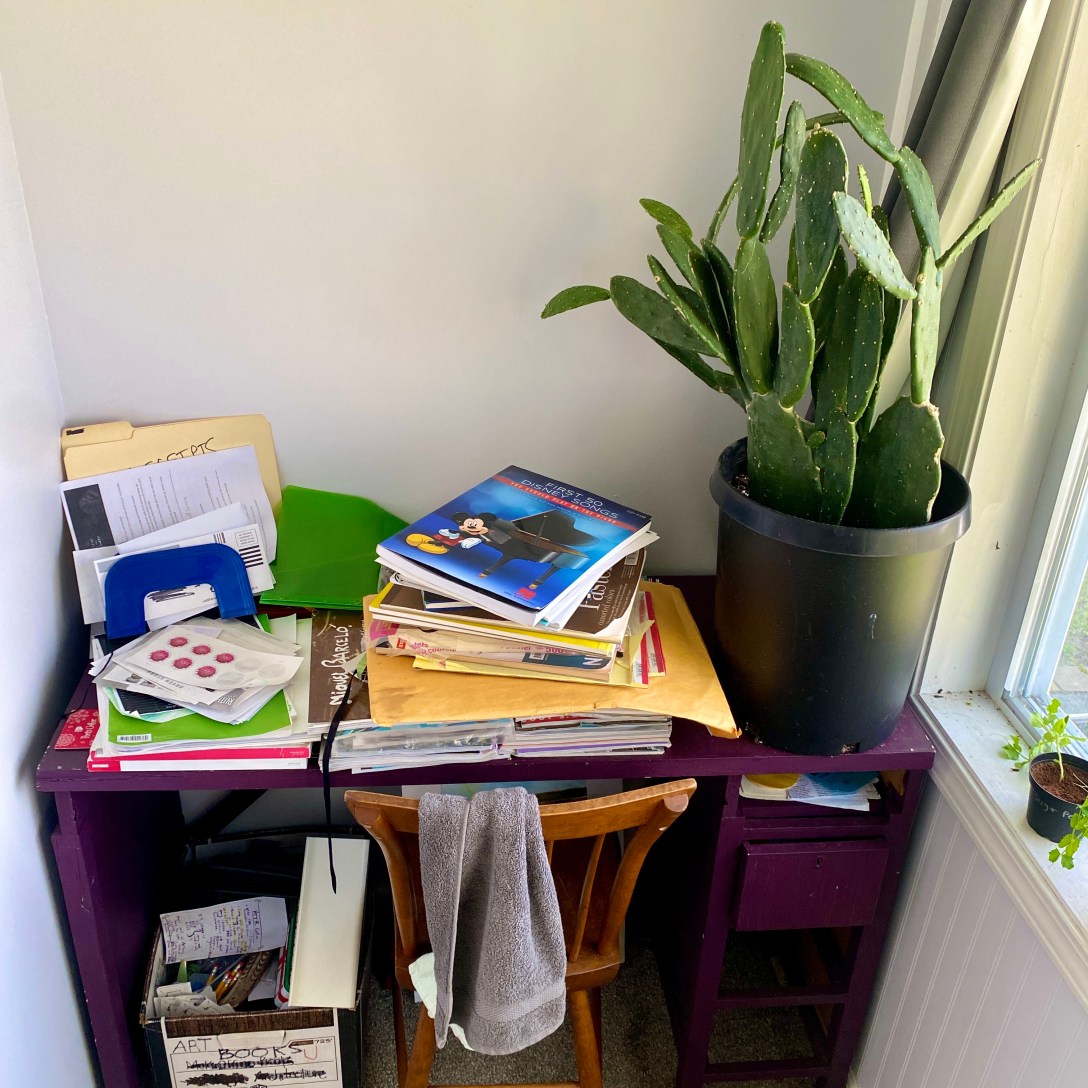
Last Tuesday, I put the endless stacks of sheets into the closet. Finally. I’m resisting editing that sentence, even though I know it’s a bad beginning. It’s really a bad sentence in general. But I’m resisting. I want to try writing this piece all at once, badly, just to get something out.
In November I did my one-blog-post-a-day challenge, and it was so fucking hard but it was so fruitful! By the end of the month, there were thirty pieces, all about different things, all written at varying levels of honesty. Almost all of them had something good hidden in them, a little gem, that I will use later. So that challenge was a success. But the problem with challenges is that when they’re over, you can let yourself off the hook. You can say “alright cool beans. I’m tired now. I’m gonna watch Netflix at night instead of forcing myself to pump out yet another blog post. Yay! Celebration! Sigh of relief!” And then you can lie to yourself and say “I’ll write one blog post a week, instead of once a day…but after I take a little break.”
So five months later, here I am! Back at it. Not doing a daily challenge this time, just writing regularly and putting stuff out there.
Just for the record – and fyi, “the record” is pretty much just my overactive need for approval and recognition, things that I mostly need from myself, that I almost never give myself, yay for therapy – I have been writing almost daily in my journal. The first evidence of journaling I have is from 2001 (I was six). My family went to visit my 20-something aunt in California. I remember feeling a strong urge to write in this sparkly purple journal she gifted me. It was so beautiful, so empty. It was waiting. At least I felt like it was. I wrote about seeing the elephant seals sunning themselves on the rocks by the ocean, my handwriting was big and loopy, and I felt this weird satisfaction from being able to write something down in a little book all my own. I liked that nobody but me would ever see it, so I could write whatever I wanted.
I wrote a year later in that journal that I thought my best friend’s father, Les, was “brainwashing my dad.” I think I had never seen my dad agree with anyone before, and the fact that he was nodding along to what Les was saying was shocking to me. I was genuinely angry and afraid for my dad, and I wrote about those feelings in my journal. A “boiling hot feeling” spread through my body. I thought my dad would lose himself completely if he acknowledged any more of Les’ opinions. It wasn’t that Les’ opinions were scary or wrong. It was that I was terrified seeing my dad accept anyone else’s perspective as valid. It wasn’t normal.
To be fair, I had also just watched the Scooby Doo live action movie where most of the characters get possessed and lose control of their bodies, so the fear of being brainwashed was pretty present in my mind.
Then there was my fourth grade teacher. Mr. Baker saw the writer in me immediately, and made it his mission to nurture that identity. He was a writer, and actually encouraged all of his fourth grade students to keep their own journals, and read pieces to the class. Pretty much all I remember of fourth grade was writing writing writing. Every single day, my best friend Sophia and I would be the last to leave the classroom. We were either the most disorganized, or the least concerned about getting out, or the most chatty, or a combination of all three, and Mr. Baker would ALWAYS send us off with a hearty “don’t forget to write!” Every singled afternoon. It stuck. I’ve kept a consistent journal since fourth grade, without fail. So. Much. Material. So. Many. Ridiculous. Stories. So. Much. Processing. I fucking love it.
And since this was originally supposed to be about clutter, I’ll just quickly describe the clutter around me in my office. I did finally put the linens away in my closet. About 8 months ago, I took them out of the closet to organize them into piles – this piles is the towels, this pile is the winter sheets, this pile is the summer sheets, etc. Very exciting. The problem was, once I organized them, I didn’t have shelves to put them on. There are not shelves in the closet, because my partner and I just haven’t had time yet to build them. So I just put the individual piles on this big white IKEA chair that we got from my parents, and left it at that. It was easy to find each thing, at least, but it was terrible because my office was basically one big linen closet all winter.
Last week I decided enough was enough. I was putting the linens back in the closet, organized, shelves or no shelves.
There’s still clutter, though. In the right corner I have all of our house documents, including our deed and other important things, in a folder waiting to be filed, along with piles of music books, a broom for cleaning the upstairs bathroom, CDs that Chris and I have no intention of listening to, paintbrushes, paints, empty photo albums, empty binders, empty journals, and a collection of old calendars from my middle school years.
In the left corner of my office sits a desk that I found on the side of the road in Vermont and toted back to Rochester. Chris and I painted it this awesome eggplant color, and now it’s covered with art magazines that are “weighing down” a collage I made a couple years ago that got a bit curled from our move. There’s also a huge prickly pear cactus that we repotted recently, thinking it would do it some good to have space, only to find that repotting it was a huge mistake. So now it’s in rehab on the purple desk. Then there’s my little blue paper organizer that holds folders of receipts and checks. It’s kind of teetering on a pile of art magazines, just barely staying up. Then there’s piles of envelopes and stamps, also perched on top of the art magazines, that I use to send poetry to my patrons. Then there’s a pile of paper of various thicknesses and colors that I use for art and poetry. And to top it all off, I have a pile of piano teaching materials sitting on top of the art paper pile.
It’s all very overwhelming once I start writing it down. But the thing is, I’m doing the best I can. I actually keep our house pretty well organized. I actually look around me with a fond amusement. I think it’s delightful how messy and in-use my office is. Eventually I’ll create zones and more shelves and blah blah blah. But for now, this is what it is. This is where I’m at. And that’s okay.
The most important shelf in my office is my journal shelf. I have all of my journals, from 2001 to the present, lined up on that shelf. My history, my healing, my process, my trauma, my experiences, my family, my friends, my pain and joys, my core and my wanderings, everything is in those journals. Most of them look different. Most of them I received as gifts. All of them I love and cherish.
On Secrets
I want to give you the full picture I promised.
You have to understand that the full picture isn’t pretty, and does not seem conducive with making money, or receiving more support from the general public. But, I think it’s important to tell the truth somewhere. And since I can’t tell it on social media (I lose followers, shed likes, and lose engagement if my posts are not sunny and hopeful and perfect), I will share it with you here.
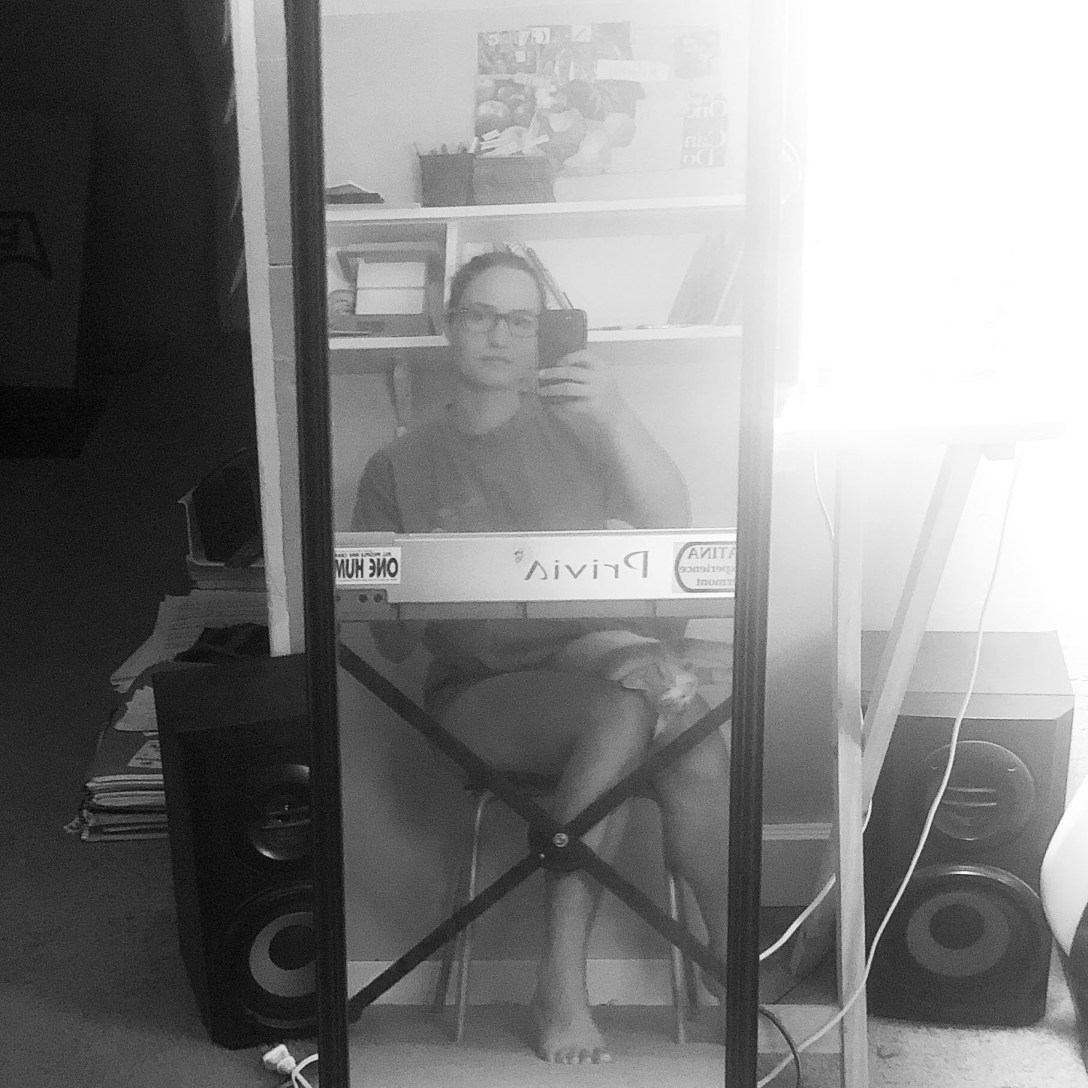
Let me back up and set the scene. I’m lying on an ugly couch in my beautiful home, cozy in a big, hooded sweatshirt from the University of Rochester, with a hot water bottle and my cat curled up at my feet. I am safe. I am panicking. There are too many people I have not called back, too many emails I have ignored and let slip into the dank muck of internet memory, too many songs I have not yet recorded, and too many opportunities I have been unable to pay attention to. I am panicking because I am not enough. Or rather, I believe I am not enough.
Two competing ideals vie for attention in my mind:
- The artistic freedom I possess in my life makes the “suffering” worthwhile.
- I am supposed to be living the dream.
Here it is in a nutshell: my innate musical talent is a gift, and thus I am encouraged to work hard to share it with other people. I practice piano and voice, create arrangements in rehearsals with my band, promote my shows online, haul my keyboard and gear to small bars, give all of my raw energy and passion to performing with my band, collect a couple hundred bucks at the end of the night, distribute the money between band members, and finally drive home, depleted, to start over the next day. I also record my songs, collaborate with audio engineers, book future shows, and maintain a Patreon community.
This is fine. It works for someone who has more tolerance than me and who gets energy from being out. I am very sensitive to noise, though, as well as socializing and being out late at night. Being out depletes my energy.
Then there’s the “making a living” part, which tends to be important for staying alive. I spend 20-30 hours a week making my music career work, not including the hours I spend teaching. Due to my sensitive nervous system, I can play about 3 live shows a month, and leave with $50-$100 bucks in my pocket. I make about $160 a month from my patrons on Patreon. With this income, at the current New York minimum wage of $13.20 per hour, I get paid for only 8 hours of work each week.
Eight. Out of thirty. At minimum wage.
So. It’s becoming clear to me that I’m doing community service when I’m working on my music. Okay. That’s fine. Community service is wonderful. The question is, is it strengthening me or slowly killing me? Is it my fault? The eternal question for everything challenging in our lives.
I don’t have an answer, and don’t think the answer is truly important, but I can at least start to think it through.
Mostly, I just want to be alone and quiet. That desire makes me feel unloveable and broken, and it also makes me feel like a failure of a musician. What musician wants to be alone and quiet most of the time? Living the life of a musician, I am almost never alone, and quiet is not the goal, to say the least. I am rehearsing with my band, or creating relationships online with my fans, or performing for a crowd at a bar who is half listening, half talking, and half numbing the stress of daily life.
These necessary, day-to-day tasks push me far past my limit. I’m so far past my limit that I can’t bring myself to call the people I love back, respond to supportive messages from friends, clean my office properly, or consider new opportunities. I’m at a standstill, trapped in the commitments I’ve already made, but unable to function properly. This is all obvious to me. I can write it out and nod my head and go “yes, I am burnt out.” But it also seems absolutely ludicrous. It’s ridiculous to me that I have such a low tolerance for stimulation, for other people’s experiences, for being out in the world. It seems impossible. I must be capable of more. I just have to bully myself into being capable of more. At least that’s what I tell myself.
We always have to answer to someone, right? I answer to my audience. And until recently, I loved doing it. I reveled in their joy, their excitement. I absorbed their energy and called it mine. But now, when I go onstage, I notice a huge disconnect between how I’m feeling on the inside and how I present to my audience on the outside. I can never go onstage and use my audience for comfort. I can’t go on and say “today has been really fucking difficult and I need some love.” They use me for comfort, not the other way around; that’s how the agreement works. The person onstage provides a respite for the people offstage. I am vulnerable, soft, exhausted in front of my audience. I try to be myself. I try to be open. I hold so much space for them. I bleed myself dry in front of a crowd of people for a couple of hours. The problem is, I cannot hold the same space for myself. At least not at the dizzying rate it would take to counteract the depletion of resources caused by performing. If I can’t love myself, or give myself the space I need to thrive, then the rest means absolutely nothing.
My life force, or energy, or whatever you want to call it, is at an all-time low, and still I push myself to play one more show, to make one more Instagram post, to keep expanding my business. That’s where I’m at, in this precious moment on my ugly couch. That’s the truth. Is this what I’m working for?
I thought I was doing all of this to build a sustainable music career. Simple. If I could gain enough financial and physical support from my fans, then I could relax a little bit and my days would be like a well-oiled machine, rather than the scrabbling rat parade they are now. I work super hard in the present so that I can relax a bit in the future. Tour the world, play big stages, make steady money, hire a team of people to book my shows, run my social media accounts, and market my music. Focus only on the music, not on all the stuff surrounding it.
But.
It turns out I want to be cozy at home with my cats instead of touring the world with my band. So why am I really doing all of this?
Because I am terrified of failing. I’m terrified of not being enough. I’m terrified of letting go.
I have so many questions. As usual.
Why do I try to expand when I can’t yet handle the work I’m currently doing? Why am I trying to build this ‘strong foundation’ when I don’t want, or don’t think I can handle, the life of a touring musician? Is not wanting the same thing as not being able to? Is there a way to do this without martyring myself? Is there a way to do ANYTHING without martyring myself? My therapist tells me there is. She says I need to stop doing third grade work when I’m still in second grade (a clever reference to me skipping second grade as a kid) so that I can succeed instead of drown.
It’s true that I am drowning. In my own ambition. I am trapped in my own skewed sense of self and responsibility.
I’m not supposed to be telling anybody this. I’m supposed to keep up a rehearsed front, in which I am always excited and grateful to be doing what I’m doing, in which I’m always proud of my work, where I consistently advocate for myself with a smile on my face and a spring in my step. I’m exhausted from all the springing and the stepping. I don’t want to advocate for myself anymore. I don’t have the capacity to do it. I just don’t.
I’m actually sick right now, came down with a bad cold. I’ve been sick for days, but I refused to let myself rest until today. I had too many things to do, too many tasks to complete, too many people to answer to.
Why?
Because I can’t fail. But I can’t keep going like this, either.
On Beauty and Strangeness
Beauty and Strangeness
drop to the sand
come, get the ropes
(who are, after all, not mild
but militant)
I don’t think I am old yet,
half asleep,
not
all at once
but steadily
I know I have already lived
Words found in Mary Oliver’s book of essays Upstream and rearranged to my heart’s content. I found the words, but was careful not to copy any phrases or pairs of words. Each word is its own island set in the fabric of this poem.
On Banana Bread

My grandma can only eat unripe bananas because of this special diet she’s on. So, when the bananas got too ripe for her to eat, I made banana bread. Yesterday was tough for me because, the night before, I had a PTSD-related panic attack. The next afternoon, I was still dealing with the residual effects of my nervous system getting completely overwhelmed. Baking is often the only thing that keeps my body regulated on days like these.
I used Ruth Reichl’s recipe for Devil’s Food Cake, and totally revamped it to create an incredible baked treat with no added sugar. The sweetness comes just from the milk, butter and bananas. The whole thing is almost gone – my grandma and I have devoured it over the past 24 hours. I will admit that this banana bread was pretty much what we ate for dinner last night.
Here’s the recipe:
1 cup milk
2 tbsp almond flour
1 tsp cinnamon
1 tsp nutmeg
½ tsp cloves
2-3 overripe bananas
½ cup butter (1 stick) – softened or at room temp
3 eggs
1 ¾ cup flour
1 tsp almond extract
2 tsp vanilla
1 ½ tsp baking soda
½ tsp salt
Optional: replace half of the butter with ½ cup apple sauce
Preheat oen to 350 F.
Heat milk in a small pan until bubbles begin to appear around the edges. Remove from heat.
Put almond flour and all three spices into a small bowl. Feel free to go overboard on the spices. I always do. Slowly beat in warm milk (I just used a fork). Let cool.
Partly mash the bananas with a fork. Then cream the butter into the banana mash mixture using the same fork. Beat in the eggs, almond extract, vanilla, and apple sauce if you’re using it (again, all you need is a fork). Add milk mixture.
Mix remaining dry ingredients together and gently blend into butter mixture. Do not overbeat.
Turn into a well-greased 8×8 square pan, and bake 20-30 minutes, depending on how gooey you want it. 25 minutes creates a perfect, moist bake, but you could underbake even more for more gooeyness.
Eat it with your grandma!
Also, yes, I understand the irony of my grandma not eating overripe bananas but then eating them in a banana bread. Who cares. YOLO.
On Real Conversations

Tonight I actually forgot that I was supposed to write a post. I worked so hard today, doing way too many things with way too much vigor. I wrote a vision/outline for a new podcast I’m starting in January, sent the stems (raw audio files) for a live album I recorded at a festival in September to two different mixing engineers, started editing my new music video, and got my Pfizer Covid booster shot.
Now, with a headache and feeling woozy from the vaccine, I’m just going to quickly write about my ideas for this podcast. My friend Ben Albert, a fellow booking manager and creative business person in Rochester, NY, started this really awesome community called Rochester Groovecast. He wants to expand his idea into a Collective, including to a diverse bunch of artists, podcasts, articles, and creative showcases.
For my podcast, I imagine interviewing artists of all kinds: musicians, visual artists, craftspeople, designers, videographers, specialty food makers, dancers, actors, writers, etc etc etc. It’s an endless list. I want to have honest conversations with these people that reveal the strength, challenges, purpose, vulnerability and joy of making music/all other art forms. I want to disassemble romantic myths about the artist’s creative process.
I’ve already made a schedule for who I want to interview each month for all of 2022. Sometime this weekend I’ll start asking the artists if they’re down to do it! Nobody gets paid, including me, but I’m hoping I can provide something useful for these creators, even if its just a media/press link they can add to their portfolio. And, someday, I’d like to get sponsorship so I can pay myself for my time, and potentially provide each interviewee with a small stipend.
I want the podcast to be a place for people to go to feel less alone. I imagine building a community around art and creating art. I envision the podcast as a real space, uninhibited by social media algorithms or marketing guidelines, kind of like how I’m approaching this blog format. I want to be unafraid, or at least unabashed. I want to encourage my interviewees to be unabashed right along with me.
On Chicken Coops
About two days ago, my grandma and I started receiving irksome texts from my dad. Where’s the chicken coop? he kept asking, I’m sure it’s on the property. He wouldn’t give it up – he even sent us pictures he had taken last year of this mysterious chicken coop that was supposedly in my grandma’s Floridian yard. The problem was, there was no chicken coop to be found. There was an old red shed, filled with mismatched chairs and gardening tools. There was a big deck, and a round outdoor table. There were palm trees and aloe growing everywhere. But no chicken coop.
My grandma made sure to clear this up with my dad. She told him that “the whole thing is gone” and that the previous owner “probably cleared it away so (the) house would sell better.” And so, after many bemused texts had been sent back and forth between my grandma and my dad, the mystery of the missing chicken coop mystery was dropped (the only person who truly dropped it was my grandma – I’m sure my dad was still agonizing over it).
Today, in a rush of inspiration, I decided to go on a search for the chicken coop. What’s the worst that could happen? I turned on “We Can Do Hard Things” by Glennon Doyle, and walked out into the sunshine of a gorgeous Florida afternoon. I felt like a brave adventurer, out to discover whatever might happen along my path.
In truth, I vaguely remembered where the chicken coop was. I was actually there when my dad first discovered it, and I remembered seeing it with him, and being astonished by this rare treasure: a relatively large chicken coop in the backyard of a house in the Florida Keys. But, because everything is generally very cloudy in my brain, I thought maybe the chicken coop had been at a different house, or that I was mixing it up with a childhood memory of a chicken coop, or that I had simply fabricated the memory of a backyard chicken coop, and now it was parading around in my mind like a real memory, trying to trick me.
So when my dad first started sending chicken coop inquiries, something dim stirred in my brain. I ignored that dim response (because it was dim) and continued on with my life. But after a couple of days, the call of the chicken coop grew too strong to resist: I knew it was out there. All I had to do was go out and find it.
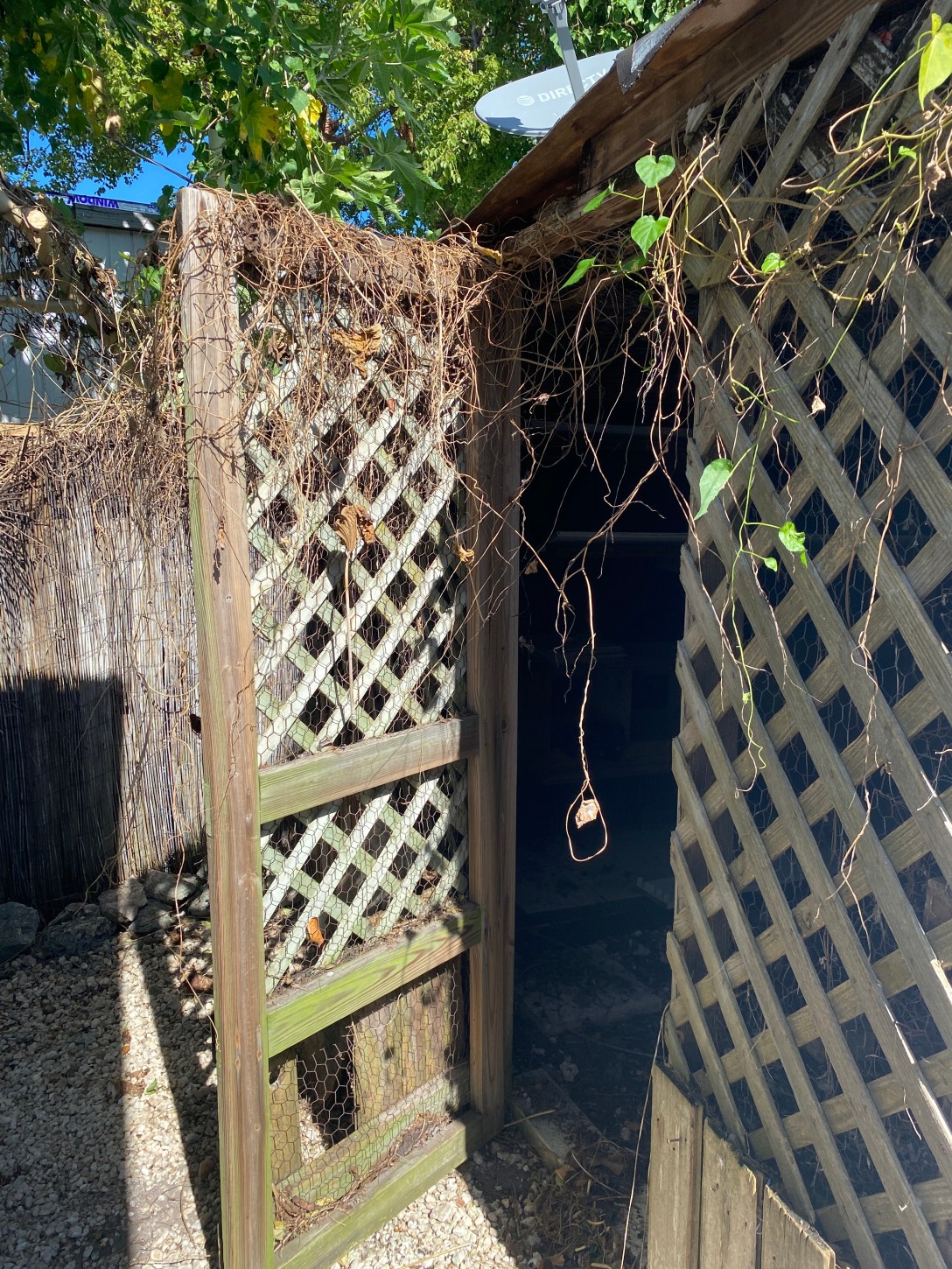
A minute later, I was standing in front of the chicken coop door. It was mostly obscured by vines. We had missed it because, until yesterday, there was a big tree covering it. We assumed the shed was a part of our neighbor’s property – we didn’t realize that we had access to a door. In that moment, I felt like Mary in The Secret Garden (I reread that book this past summer – there is some problematic racism in it, but I still connected, on a deep level, with the story of a girl growing healthy by spending so much time playing outside) finding the door for the first time.
I yanked it a couple of times, and it opened. Then, I snapped a few pics to send to the group text with my dad and my grandma. Proof. And then I went back inside and continued on with my day.
Moral of the story? What you’re looking for might just be right in front of you.
Just kidding. There’s no moral. It’s just really ridiculous that my grandma and I didn’t know there was a chicken coop in our backyard.
On Driftwood

This morning my grandma and I woke up in the darkness at 6am to shoot a music video.
We wouldn’t have done this, except we were walking along a remote beach last week, and came across this abandoned homestead made of driftwood. There once was a community of people living here, my grandma said: I used to see them when I walked my dog down here years ago. In place of the colorful tents and long-haired men that once nestled into the sand, only a driftwood castle remained. They built this massive, angular structure, the center of their village, the gathering place. They tied emblems to the ends of the bone-dry branches: old Nikes, beautiful glass bottles, buoys, and strips of colorful ribbon. They painted a few branches with vibrant blues, yellows, and pinks, penning all-seeing eyes and names of past lovers. They put up a plaque for someone named “Red” who died there in 2009. There were clear outlines of different rooms, like the Aztec ruins in New Mexico.
When we first came across the driftwood complex, I felt like I was in Peter Pan’s wonderland. The place had magic. I felt so inspired. I casually mentioned how great it would be to shoot a music video there, and my grandma said, why not? We should do it.
I don’t think many people can say that their grandma was the videographer for their music video. I’m feeling really blessed to be in this position. My grandma happens to be a really masterful photographer, so she’s accustomed to being behind the camera, and was really excited about collaborating on this project with me. And I’m accustomed to being in front of it – it’s part of my job as a professional musician. I especially love shooting music videos where I’m interacting with nature – I shot one on an iPhone camera last fall, and made one with Lilac Milk last winter.
So this morning we drove out to the beach for sunrise and shot the first footage for the new music video for my song Meteor. In the castle on the sand.
On Soulmates

Are we meant to find our soul mate? Do we have only one, or are there lots? Is this just another idea for us to gather around, warm our hands against, and use to make meaning out of our relatively meaningless lives?
Here’s what the internet has to say on the matter (you can read the full articles by clicking on the titles):
Wikipedia: “In current usage, “soulmate” usually refers to a romantic or platonic partner, with the implication of an exclusive lifelong bond. It commonly holds the connotation of being the strongest bond with another person that one can achieve. It is commonly accepted that one will feel ‘complete’ once they have found their soulmate, as it is partially in the perceived definition that two souls are meant to unite. The term “soulmate” first appeared in the English language in a letter by Samuel Taylor Coleridge in 1822.”
Ooookay. There’s a lot to unpack here. The thing that sticks out the most to me is that this definition stresses an all-or-nothing type of partner. You’re gonna be with this person for all of your remaining breaths, and you are not whole without this person. This is the definition of “soul mate” I encounter the most. It makes me feel nervous and confined.
Merriam-Webster: “1) a person who is perfectly suited to another in temperament
2) a person who strongly resembles another in attitudes or beliefs”
This is a really funny one. The thing is, I would never, ever want to be with someone who resembles me in attitude. I just wouldn’t. So, by this definition, would I not want to hang out with my soul mate? I honestly don’t think I could make it one day hanging out with myself (what’s that? I live with myself every day? Oh yeah. Well, I don’t want any more of me around. That’s all I’m saying).
The Atlantic: “Take the idea of romantic destiny, or “soul mates”—the belief that two people are deliberately brought together by unseen forces…Believing in soul mates is functionally the same as believing that if you get a certain job, achieve financial independence, or move to a sunny place, you will have true and lasting satisfaction. Nothing is more human than this belief, which keeps us hopeful in spite of our negative experiences. But it is a recipe for unhappiness. We cannot attain permanent satisfaction—at least, not in this mortal coil—and waiting for it will leave us disappointed over and over again.”
This realist view really resonates with me. It makes me feel like I have power in my own trajectory. I get a calm, contented feeling, knowing that a relationship will be sustained not by a mysterious, ethereal force, but by my own decisions and response to challenges.
Seventeen: “Wondering if your bae is the perfect match? Here are 18 signs that will help you know if you’ve found your true connection.
1) You just know it. There is no test that will help you determine if you’ve found your soulmate or not. To figure it out, you just have to know it. You have to feel it in your gut, that this person is the right one for you.
Alright. You know what? I’m tired of hearing this bullshit over and over.
One time, when I was 15, I caught sight of a super cute guy at a traffic light one summer. I had been driving around like a hooligan with a group of friends. Egged on by loud whoops from everyone in the car, I leaned out of the open window and asked this guy if he would marry me. He said yes. Then we pulled over after the light turned green and had a little wedding ceremony. I knew he was The One – in that single, summer evening moment.
I know that’s an extreme example. But we aren’t living in some masterpiece painting, where we work on a single painting for our entire lives, always with the same color scheme, the same brush strokes, always keeping an image of the finished product in our minds. Our lives are more like leftovers soup. We’re pawing through the fridge, finding the old broccoli that nobody wanted to eat, chopping up celery, throwing some chicken in there, and stirring it around, shaking various spices in, just improvising our way through this lumpy bullshit. And then, in the end, it’s fucking delicious. Maybe not in the exact way we thought, but it is!
Brides.com: “You might be wondering if you met your soulmate on a vacation, subway stop, or that time in the rain when a stranger invited you to share an umbrella—but didn’t realize it at the time. According to Dr. Tobin, yes, this is possible. “Everything in life is about timing. I believe it’s a matter of self-knowledge. When you understand that a relationship is not about control or the simple need of fulfillment but is essential to our psychological and spiritual development, then you’re open to the possibility of meeting your soulmate.”’
YES. Yes to this. I never would have thought that I’d have a full fuck-yes to something written by Brides.com, but there we go.
Here’s what I think: I think we have lots of soulmates. Not just one. I think a soulmate can be a romantic partner, a friend, a pet, or even a stranger who you lock eyes with on the street for a split second. Sue me.
I understand having a gut feeling about someone and following that. You make decisions based on your gut feeling, and you just keep doing the next right thing. I’m doing that right now with my partner, who I love deeply. What I don’t understand, and don’t accept as true, is the other part of Seventeen’s claim: that you just know it. Life is so complicated as it is. Sometimes I don’t know what to eat for breakfast. Sometimes it takes a little bit of recalibrating, rest, or space to be able to come back to my “knowing.” I don’t “just know” anything. And I don’t want to. I’m just here improvising.
Here’s one more article, in case you really want to delve deeper into the soulmate idea.
One-Time
Monthly
Yearly
Help me continue writing & making art
Help me continue writing & making art – every month
Help me continue writing & making art – every year
Choose an amount
¤5.00
¤15.00
¤100.00
¤5.00
¤15.00
¤100.00
¤5.00
¤15.00
¤100.00
Or enter a custom amount
¤
Thank you so very much. Your generosity and support really make a difference.
Thank you so very much. Your generosity and support really make a difference.
Thank you so very much. Your generosity and support really make a difference.
DonateDonate monthlyDonate yearlyOn Empathy & Secondary Traumatic Stress
Empathy is all at once a loaded word and a cliched idea in 2021. I want to explore the shadow side of this omnipresent buzzword. What is empathy, really? The Berkeley definition is “the ability to sense other people’s emotions, coupled with the ability to imagine what someone else might be thinking or feeling.” This seems doable. Imagining what someone else is feeling could be as simple as procuring an image of a raincloud in your head when someone says they’re feeling gloomy.
However, Google Dictionary’s definition of empathy is “the ability to understand and share the feelings of another.” The ability to share the feelings of another. This is all well and good when you’re empathetic towards someone because they’re feeling grief or joy: these sentiments are breeding grounds for connection and vulnerability.
But what happens when the other person’s feelings consist of self-hate, suicidal urges, and severe disdain for other people? Where does that leave you, after you’ve employed consistent empathy for that person? Filled with a desire to not be alive anymore, and an acute loathing of basic humanity? Is that helpful to anyone? Is that good?
These questions are important to me because empathy used to be one of my strengths. I had an uncanny ability to feel into what others were feeling, so much so that when I watched TV with my best friend, she would catch me mirroring the exact facial expressions of the actors on the screen. She’d call me out on it, and I would be startled, not even realizing I was contorting my face to match the ones on the screen. I’d come back into consciousness to find my mouth had formed a deep frown, or my eyebrows knit together in an angry face. I was doing it completely subconsciously. I wasn’t able to control my empathy.
And then, it wasn’t a strength anymore. It was a window, a soft gap where other people’s brutal feelings could infiltrate and settle into my body.
Brené Brown asserts that “empathy is a choice, and it’s a vulnerable choice. In order to connect with you, I have to connect with something in myself that knows that feeling.” But what if empathy isn’t a choice at all? What if you’ve been in a state of empathy for so long that it’s a simple habit, a continuous way of being? Then it could be very dangerous.
At what point does empathy become stupidity? And are there people who are carrying too much pain inside of them, trauma that they are unwilling to face, who pose a real threat to the people who care about them?
I know this is a controversial thing to suggest, because the “good” thing to do would be to empathize with somebody who is in pain. Right? Someone who is in pain needs outside help. Pain is not meant to be dealt with alone. And I know the word “threat” is extremely charged. I don’t mean that the person in pain intentionally hurts others. But unchecked pain is catching.
When I was 18, I met a sociopath. I disliked him when I met him. My gut reaction was to crinkle my nose and ignore his impish quips. I could see that he was terrified and small, underneath his contempt for others and boyish bravado. But something about his quick, bird-like movements and strange, old-fashioned speech intrigued me. He was attractive, in a disconcerting, “I want to put you under my wing and keep you there” sort of way. He was carrying immense trauma; he had been regularly beaten as a child, and only knew how to give and receive love through violence. He made me uncomfortable, and I thought that was an indication that he would challenge me: that I was about to learn a lot about myself and the world. I was a free-spirited, confident young woman, ready to take on anything.
Flash forward 2 years. All that time, I’d been engaging with this person, being fully empathetic to his experience, seeing things through his eyes, reveling in the entirely different way he saw the world (as a cold, loveless place where one had to be aggressive and hateful to exist as an individual). I had surrendered to empathy, because that was how I knew how to love and attend to someone. By the end of those two years, I was suicidal, had developed debilitating anxiety, woke up nightly with sheets drenched in sweat, no longer felt desire for anything, was insecure to the point of hating myself constantly, and felt shock/surprise if someone touched me in a loving way. The joy had vacated my body – all that was left was over-arousal, despair, and a torturous memory of the person I’d been before.
Years later, partially healed, I started teaching music at a charter school, a job I was extremely ill-prepared for. The principal had me read up on Secondary Traumatic Stress. The National Education Association writes that “educators can begin exhibiting symptoms similar to those of their students – withdrawal, anxiety, depression, and chronic fatigue” even if they haven’t experienced trauma themselves. This is a well-researched, fully-fledged fact: that educators develop what’s called “compassion fatigue” when faced with their students’ trauma every day in the classroom.
I personally experienced Secondary Traumatic Stress after only a couple of months of working with about 100 kids as their music teacher. Kids accused me of physically harming them when I didn’t. They touched me inappropriately and called me names. They were constantly terrified that everyone, including me, was out to get them. Most of them didn’t feel safe anywhere. Some told me that they were worried every second of every day that their parents would be killed.
I, still carrying my own traumas inside of me while trying to take care of these traumatized kids, crumpled. I started having panic attacks almost daily: loud, urgent affairs where I screamed and screamed, desperate for some relief or catharsis that wouldn’t come. I couldn’t greet my partner upon arriving home after the work day, because even the slightest touch or word directed at me felt explosive. Loud noises made me feel like I was being beaten over the head with a baseball bat. I was a shell of a human.
Could I empathize with these kids (share these kids’ terror) without wasting away into this fragile humanoid creature? No. Could I genuinely teach them without being empathetic to their experiences? No. So I left the job.
I think it’s interesting that, as the use of the word “empathy” has increased over the years since the 1940s, so has the use of the words “anxiety,” “trauma,” and “relationship.” There seems to be a correlation between the prevalence of “empathy” and “anxiety” in the English language. I don’t think this is a coincidence. I think, based on my experience, this parallel upwards trajectory of anxiety and empathy in our culture makes a lot of sense.
Is empathy inherently dangerous? No. Does trauma always breed trauma? No. But I think it’s important to talk about how empathy isn’t all sunshine and rainbows. If we sacrifice our own experience of the world in favor of being empathetic, we risk being worn down. In that state, we can’t help anyone at all. Empathy should never be all-encompassing, as tempting as it may be to surrender to someone else’s experience. It has to be done with regard for the Self, and the Self’s desires. This might be obvious to most people, but for most of my life, it wasn’t obvious to me. So I’m writing about it.
 Siena Rose