On Clutter

Last Tuesday, I put the endless stacks of sheets into the closet. Finally. I’m resisting editing that sentence, even though I know it’s a bad beginning. It’s really a bad sentence in general. But I’m resisting. I want to try writing this piece all at once, badly, just to get something out.

In November I did my one-blog-post-a-day challenge, and it was so fucking hard but it was so fruitful! By the end of the month, there were thirty pieces, all about different things, all written at varying levels of honesty. Almost all of them had something good hidden in them, a little gem, that I will use later. So that challenge was a success. But the problem with challenges is that when they’re over, you can let yourself off the hook. You can say “alright cool beans. I’m tired now. I’m gonna watch Netflix at night instead of forcing myself to pump out yet another blog post. Yay! Celebration! Sigh of relief!” And then you can lie to yourself and say “I’ll write one blog post a week, instead of once a day…but after I take a little break.”

So five months later, here I am! Back at it. Not doing a daily challenge this time, just writing regularly and putting stuff out there.

Just for the record – and fyi, “the record” is pretty much just my overactive need for approval and recognition, things that I mostly need from myself, that I almost never give myself, yay for therapy – I have been writing almost daily in my journal. The first evidence of journaling I have is from 2001 (I was six). My family went to visit my 20-something aunt in California. I remember feeling a strong urge to write in this sparkly purple journal she gifted me. It was so beautiful, so empty. It was waiting. At least I felt like it was. I wrote about seeing the elephant seals sunning themselves on the rocks by the ocean, my handwriting was big and loopy, and I felt this weird satisfaction from being able to write something down in a little book all my own. I liked that nobody but me would ever see it, so I could write whatever I wanted.

I wrote a year later in that journal that I thought my best friend’s father, Les, was “brainwashing my dad.” I think I had never seen my dad agree with anyone before, and the fact that he was nodding along to what Les was saying was shocking to me. I was genuinely angry and afraid for my dad, and I wrote about those feelings in my journal. A “boiling hot feeling” spread through my body. I thought my dad would lose himself completely if he acknowledged any more of Les’ opinions. It wasn’t that Les’ opinions were scary or wrong. It was that I was terrified seeing my dad accept anyone else’s perspective as valid. It wasn’t normal.

To be fair, I had also just watched the Scooby Doo live action movie where most of the characters get possessed and lose control of their bodies, so the fear of being brainwashed was pretty present in my mind.

Then there was my fourth grade teacher. Mr. Baker saw the writer in me immediately, and made it his mission to nurture that identity. He was a writer, and actually encouraged all of his fourth grade students to keep their own journals, and read pieces to the class. Pretty much all I remember of fourth grade was writing writing writing. Every single day, my best friend Sophia and I would be the last to leave the classroom. We were either the most disorganized, or the least concerned about getting out, or the most chatty, or a combination of all three, and Mr. Baker would ALWAYS send us off with a hearty “don’t forget to write!” Every singled afternoon. It stuck. I’ve kept a consistent journal since fourth grade, without fail. So. Much. Material. So. Many. Ridiculous. Stories. So. Much. Processing. I fucking love it.

And since this was originally supposed to be about clutter, I’ll just quickly describe the clutter around me in my office. I did finally put the linens away in my closet. About 8 months ago, I took them out of the closet to organize them into piles – this piles is the towels, this pile is the winter sheets, this pile is the summer sheets, etc. Very exciting. The problem was, once I organized them, I didn’t have shelves to put them on. There are not shelves in the closet, because my partner and I just haven’t had time yet to build them. So I just put the individual piles on this big white IKEA chair that we got from my parents, and left it at that. It was easy to find each thing, at least, but it was terrible because my office was basically one big linen closet all winter.

Last week I decided enough was enough. I was putting the linens back in the closet, organized, shelves or no shelves.

There’s still clutter, though. In the right corner I have all of our house documents, including our deed and other important things, in a folder waiting to be filed, along with piles of music books, a broom for cleaning the upstairs bathroom, CDs that Chris and I have no intention of listening to, paintbrushes, paints, empty photo albums, empty binders, empty journals, and a collection of old calendars from my middle school years.

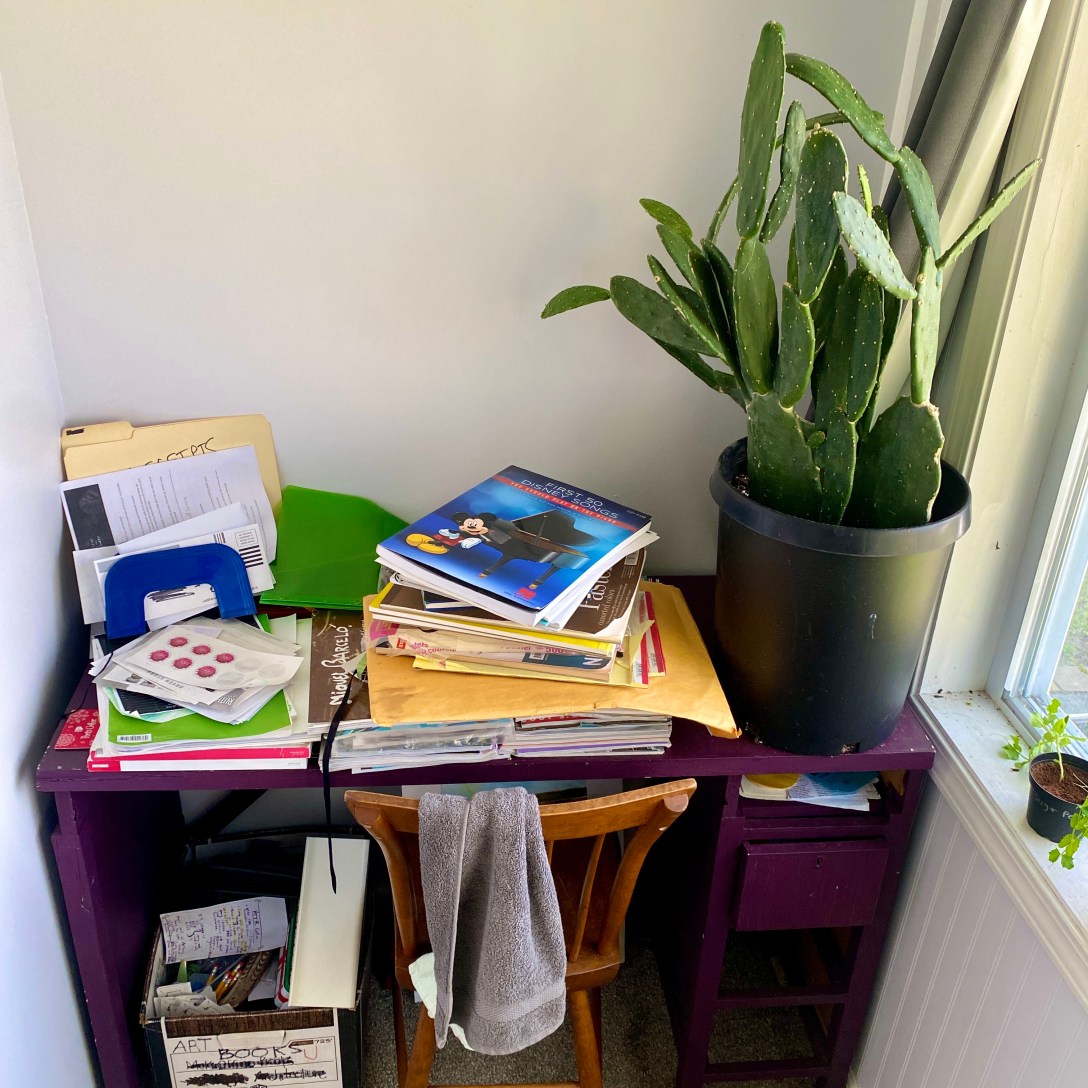
In the left corner of my office sits a desk that I found on the side of the road in Vermont and toted back to Rochester. Chris and I painted it this awesome eggplant color, and now it’s covered with art magazines that are “weighing down” a collage I made a couple years ago that got a bit curled from our move. There’s also a huge prickly pear cactus that we repotted recently, thinking it would do it some good to have space, only to find that repotting it was a huge mistake. So now it’s in rehab on the purple desk. Then there’s my little blue paper organizer that holds folders of receipts and checks. It’s kind of teetering on a pile of art magazines, just barely staying up. Then there’s piles of envelopes and stamps, also perched on top of the art magazines, that I use to send poetry to my patrons. Then there’s a pile of paper of various thicknesses and colors that I use for art and poetry. And to top it all off, I have a pile of piano teaching materials sitting on top of the art paper pile.

It’s all very overwhelming once I start writing it down. But the thing is, I’m doing the best I can. I actually keep our house pretty well organized. I actually look around me with a fond amusement. I think it’s delightful how messy and in-use my office is. Eventually I’ll create zones and more shelves and blah blah blah. But for now, this is what it is. This is where I’m at. And that’s okay.

The most important shelf in my office is my journal shelf. I have all of my journals, from 2001 to the present, lined up on that shelf. My history, my healing, my process, my trauma, my experiences, my family, my friends, my pain and joys, my core and my wanderings, everything is in those journals. Most of them look different. Most of them I received as gifts. All of them I love and cherish.
On Secrets

I want to give you the full picture I promised.

You have to understand that the full picture isn’t pretty, and does not seem conducive with making money, or receiving more support from the general public. But, I think it’s important to tell the truth somewhere. And since I can’t tell it on social media (I lose followers, shed likes, and lose engagement if my posts are not sunny and hopeful and perfect), I will share it with you here.

Let me back up and set the scene. I’m lying on an ugly couch in my beautiful home, cozy in a big, hooded sweatshirt from the University of Rochester, with a hot water bottle and my cat curled up at my feet. I am safe. I am panicking. There are too many people I have not called back, too many emails I have ignored and let slip into the dank muck of internet memory, too many songs I have not yet recorded, and too many opportunities I have been unable to pay attention to. I am panicking because I am not enough. Or rather, I believe I am not enough.

Two competing ideals vie for attention in my mind:

  1. The artistic freedom I possess in my life makes the “suffering” worthwhile.
  2. I am supposed to be living the dream.

Here it is in a nutshell: my innate musical talent is a gift, and thus I am encouraged to work hard to share it with other people. I practice piano and voice, create arrangements in rehearsals with my band, promote my shows online, haul my keyboard and gear to small bars, give all of my raw energy and passion to performing with my band, collect a couple hundred bucks at the end of the night, distribute the money between band members, and finally drive home, depleted, to start over the next day. I also record my songs, collaborate with audio engineers, book future shows, and maintain a Patreon community.

This is fine. It works for someone who has more tolerance than me and who gets energy from being out. I am very sensitive to noise, though, as well as socializing and being out late at night. Being out depletes my energy.

Then there’s the “making a living” part, which tends to be important for staying alive. I spend 20-30 hours a week making my music career work, not including the hours I spend teaching. Due to my sensitive nervous system, I can play about 3 live shows a month, and leave with $50-$100 bucks in my pocket. I make about $160 a month from my patrons on Patreon. With this income, at the current New York minimum wage of $13.20 per hour, I get paid for only 8 hours of work each week.

Eight. Out of thirty. At minimum wage.

So. It’s becoming clear to me that I’m doing community service when I’m working on my music. Okay. That’s fine. Community service is wonderful. The question is, is it strengthening me or slowly killing me? Is it my fault? The eternal question for everything challenging in our lives.

I don’t have an answer, and don’t think the answer is truly important, but I can at least start to think it through.

Mostly, I just want to be alone and quiet. That desire makes me feel unloveable and broken, and it also makes me feel like a failure of a musician. What musician wants to be alone and quiet most of the time? Living the life of a musician, I am almost never alone, and quiet is not the goal, to say the least. I am rehearsing with my band, or creating relationships online with my fans, or performing for a crowd at a bar who is half listening, half talking, and half numbing the stress of daily life.

These necessary, day-to-day tasks push me far past my limit. I’m so far past my limit that I can’t bring myself to call the people I love back, respond to supportive messages from friends, clean my office properly, or consider new opportunities. I’m at a standstill, trapped in the commitments I’ve already made, but unable to function properly. This is all obvious to me. I can write it out and nod my head and go “yes, I am burnt out.” But it also seems absolutely ludicrous. It’s ridiculous to me that I have such a low tolerance for stimulation, for other people’s experiences, for being out in the world. It seems impossible. I must be capable of more. I just have to bully myself into being capable of more. At least that’s what I tell myself.

We always have to answer to someone, right? I answer to my audience. And until recently, I loved doing it. I reveled in their joy, their excitement. I absorbed their energy and called it mine. But now, when I go onstage, I notice a huge disconnect between how I’m feeling on the inside and how I present to my audience on the outside. I can never go onstage and use my audience for comfort. I can’t go on and say “today has been really fucking difficult and I need some love.” They use me for comfort, not the other way around; that’s how the agreement works. The person onstage provides a respite for the people offstage. I am vulnerable, soft, exhausted in front of my audience. I try to be myself. I try to be open. I hold so much space for them. I bleed myself dry in front of a crowd of people for a couple of hours. The problem is, I cannot hold the same space for myself. At least not at the dizzying rate it would take to counteract the depletion of resources caused by performing. If I can’t love myself, or give myself the space I need to thrive, then the rest means absolutely nothing.

My life force, or energy, or whatever you want to call it, is at an all-time low, and still I push myself to play one more show, to make one more Instagram post, to keep expanding my business. That’s where I’m at, in this precious moment on my ugly couch. That’s the truth. Is this what I’m working for?

I thought I was doing all of this to build a sustainable music career. Simple. If I could gain enough financial and physical support from my fans, then I could relax a little bit and my days would be like a well-oiled machine, rather than the scrabbling rat parade they are now. I work super hard in the present so that I can relax a bit in the future. Tour the world, play big stages, make steady money, hire a team of people to book my shows, run my social media accounts, and market my music. Focus only on the music, not on all the stuff surrounding it.

But.

It turns out I want to be cozy at home with my cats instead of touring the world with my band. So why am I really doing all of this?

Because I am terrified of failing. I’m terrified of not being enough. I’m terrified of letting go.

I have so many questions. As usual.

Why do I try to expand when I can’t yet handle the work I’m currently doing? Why am I trying to build this ‘strong foundation’ when I don’t want, or don’t think I can handle, the life of a touring musician? Is not wanting the same thing as not being able to? Is there a way to do this without martyring myself? Is there a way to do ANYTHING without martyring myself? My therapist tells me there is. She says I need to stop doing third grade work when I’m still in second grade (a clever reference to me skipping second grade as a kid) so that I can succeed instead of drown.

It’s true that I am drowning. In my own ambition. I am trapped in my own skewed sense of self and responsibility.

I’m not supposed to be telling anybody this. I’m supposed to keep up a rehearsed front, in which I am always excited and grateful to be doing what I’m doing, in which I’m always proud of my work, where I consistently advocate for myself with a smile on my face and a spring in my step. I’m exhausted from all the springing and the stepping. I don’t want to advocate for myself anymore. I don’t have the capacity to do it. I just don’t.

I’m actually sick right now, came down with a bad cold. I’ve been sick for days, but I refused to let myself rest until today. I had too many things to do, too many tasks to complete, too many people to answer to.

Why?

Because I can’t fail. But I can’t keep going like this, either.

On Beauty and Strangeness

Beauty and Strangeness
drop to the sand

come, get the ropes
(who are, after all, not mild
but militant)

I don’t think I am old yet,
half asleep,
not
all at once
but steadily

I know I have already lived


Words found in Mary Oliver’s book of essays Upstream and rearranged to my heart’s content. I found the words, but was careful not to copy any phrases or pairs of words. Each word is its own island set in the fabric of this poem.

On Banana Bread

My grandma can only eat unripe bananas because of this special diet she’s on. So, when the bananas got too ripe for her to eat, I made banana bread. Yesterday was tough for me because, the night before, I had a PTSD-related panic attack. The next afternoon, I was still dealing with the residual effects of my nervous system getting completely overwhelmed. Baking is often the only thing that keeps my body regulated on days like these.

I used Ruth Reichl’s recipe for Devil’s Food Cake, and totally revamped it to create an incredible baked treat with no added sugar. The sweetness comes just from the milk, butter and bananas. The whole thing is almost gone – my grandma and I have devoured it over the past 24 hours. I will admit that this banana bread was pretty much what we ate for dinner last night.

Here’s the recipe:

1 cup milk
2 tbsp almond flour
1 tsp cinnamon
1 tsp nutmeg
½ tsp cloves
2-3 overripe bananas
½ cup butter (1 stick) – softened or at room temp
3 eggs
1 ¾ cup flour
1 tsp almond extract
2 tsp vanilla
1 ½ tsp baking soda
½ tsp salt
Optional: replace half of the butter with ½ cup apple sauce

Preheat oen to 350 F.

Heat milk in a small pan until bubbles begin to appear around the edges. Remove from heat.

Put almond flour and all three spices into a small bowl. Feel free to go overboard on the spices. I always do. Slowly beat in warm milk (I just used a fork). Let cool.

Partly mash the bananas with a fork. Then cream the butter into the banana mash mixture using the same fork. Beat in the eggs, almond extract, vanilla, and apple sauce if you’re using it (again, all you need is a fork). Add milk mixture.

Mix remaining dry ingredients together and gently blend into butter mixture. Do not overbeat.

Turn into a well-greased 8×8 square pan, and bake 20-30 minutes, depending on how gooey you want it. 25 minutes creates a perfect, moist bake, but you could underbake even more for more gooeyness.

Eat it with your grandma!

Also, yes, I understand the irony of my grandma not eating overripe bananas but then eating them in a banana bread. Who cares. YOLO.

On Empathy & Secondary Traumatic Stress

Empathy is all at once a loaded word and a cliched idea in 2021. I want to explore the shadow side of this omnipresent buzzword. What is empathy, really? The Berkeley definition is “the ability to sense other people’s emotions, coupled with the ability to imagine what someone else might be thinking or feeling.” This seems doable. Imagining what someone else is feeling could be as simple as procuring an image of a raincloud in your head when someone says they’re feeling gloomy.

However, Google Dictionary’s definition of empathy is “the ability to understand and share the feelings of another.” The ability to share the feelings of another. This is all well and good when you’re empathetic towards someone because they’re feeling grief or joy: these sentiments are breeding grounds for connection and vulnerability.

But what happens when the other person’s feelings consist of self-hate, suicidal urges, and severe disdain for other people? Where does that leave you, after you’ve employed consistent empathy for that person? Filled with a desire to not be alive anymore, and an acute loathing of basic humanity? Is that helpful to anyone? Is that good?

These questions are important to me because empathy used to be one of my strengths. I had an uncanny ability to feel into what others were feeling, so much so that when I watched TV with my best friend, she would catch me mirroring the exact facial expressions of the actors on the screen. She’d call me out on it, and I would be startled, not even realizing I was contorting my face to match the ones on the screen. I’d come back into consciousness to find my mouth had formed a deep frown, or my eyebrows knit together in an angry face. I was doing it completely subconsciously. I wasn’t able to control my empathy.

And then, it wasn’t a strength anymore. It was a window, a soft gap where other people’s brutal feelings could infiltrate and settle into my body.

Brené Brown asserts that “empathy is a choice, and it’s a vulnerable choice. In order to connect with you, I have to connect with something in myself that knows that feeling.” But what if empathy isn’t a choice at all? What if you’ve been in a state of empathy for so long that it’s a simple habit, a continuous way of being? Then it could be very dangerous.

At what point does empathy become stupidity? And are there people who are carrying too much pain inside of them, trauma that they are unwilling to face, who pose a real threat to the people who care about them?

I know this is a controversial thing to suggest, because the “good” thing to do would be to empathize with somebody who is in pain. Right? Someone who is in pain needs outside help. Pain is not meant to be dealt with alone. And I know the word “threat” is extremely charged. I don’t mean that the person in pain intentionally hurts others. But unchecked pain is catching.

When I was 18, I met a sociopath. I disliked him when I met him. My gut reaction was to crinkle my nose and ignore his impish quips. I could see that he was terrified and small, underneath his contempt for others and boyish bravado. But something about his quick, bird-like movements and strange, old-fashioned speech intrigued me. He was attractive, in a disconcerting, “I want to put you under my wing and keep you there” sort of way. He was carrying immense trauma; he had been regularly beaten as a child, and only knew how to give and receive love through violence. He made me uncomfortable, and I thought that was an indication that he would challenge me: that I was about to learn a lot about myself and the world. I was a free-spirited, confident young woman, ready to take on anything.

Flash forward 2 years. All that time, I’d been engaging with this person, being fully empathetic to his experience, seeing things through his eyes, reveling in the entirely different way he saw the world (as a cold, loveless place where one had to be aggressive and hateful to exist as an individual). I had surrendered to empathy, because that was how I knew how to love and attend to someone. By the end of those two years, I was suicidal, had developed debilitating anxiety, woke up nightly with sheets drenched in sweat, no longer felt desire for anything, was insecure to the point of hating myself constantly, and felt shock/surprise if someone touched me in a loving way. The joy had vacated my body – all that was left was over-arousal, despair, and a torturous memory of the person I’d been before.

Years later, partially healed, I started teaching music at a charter school, a job I was extremely ill-prepared for. The principal had me read up on Secondary Traumatic Stress. The National Education Association writes that “educators can begin exhibiting symptoms similar to those of their students – withdrawal, anxiety, depression, and chronic fatigue” even if they haven’t experienced trauma themselves. This is a well-researched, fully-fledged fact: that educators develop what’s called “compassion fatigue” when faced with their students’ trauma every day in the classroom.

I personally experienced Secondary Traumatic Stress after only a couple of months of working with about 100 kids as their music teacher. Kids accused me of physically harming them when I didn’t. They touched me inappropriately and called me names. They were constantly terrified that everyone, including me, was out to get them. Most of them didn’t feel safe anywhere. Some told me that they were worried every second of every day that their parents would be killed.

I, still carrying my own traumas inside of me while trying to take care of these traumatized kids, crumpled. I started having panic attacks almost daily: loud, urgent affairs where I screamed and screamed, desperate for some relief or catharsis that wouldn’t come. I couldn’t greet my partner upon arriving home after the work day, because even the slightest touch or word directed at me felt explosive. Loud noises made me feel like I was being beaten over the head with a baseball bat. I was a shell of a human.

Could I empathize with these kids (share these kids’ terror) without wasting away into this fragile humanoid creature? No. Could I genuinely teach them without being empathetic to their experiences? No. So I left the job.

I think it’s interesting that, as the use of the word “empathy” has increased over the years since the 1940s, so has the use of the words “anxiety,” “trauma,” and “relationship.” There seems to be a correlation between the prevalence of “empathy” and “anxiety” in the English language. I don’t think this is a coincidence. I think, based on my experience, this parallel upwards trajectory of anxiety and empathy in our culture makes a lot of sense.

Is empathy inherently dangerous? No. Does trauma always breed trauma? No. But I think it’s important to talk about how empathy isn’t all sunshine and rainbows. If we sacrifice our own experience of the world in favor of being empathetic, we risk being worn down. In that state, we can’t help anyone at all. Empathy should never be all-encompassing, as tempting as it may be to surrender to someone else’s experience. It has to be done with regard for the Self, and the Self’s desires. This might be obvious to most people, but for most of my life, it wasn’t obvious to me. So I’m writing about it.

On Decisions

I woke up this morning and shuffled to the bedroom door. What followed was a mess of decisions, routine, habit, emotion, and, like it or not, just plain humanness. What followed was a mess. A beautiful, powerful, ordinary, exhausting, comical mess. A regular day. A regular day where I made so many tiny decisions, each one influencing the next, and influencing the people around me. What a complex web we weave around ourselves!

MORNING
walked out of the bedroom door
thought about boiling water for coffee, but didn’t
thought about picking up my phone
gratitude for coffee
more gratitude for coffee
dragged my feet to the bathroom
while peeing, considered not working out
tried to justify not working out (“I’m sore from yesterday, I didn’t get enough sleep,” etc)
realized that was bullshit
brushed my teeth while dreading working out
realized I could drink coffee right before my work out
got considerably more excited to be alive
turned on the shower accidentally (that was my habit before I started working out in the mornings)
turned off the shower
felt sheepish
walked to the stove to put on the water to boil
went back to the bedroom to pull on my workout clothes
walked out of my bedroom, forgot why I walked out, then walked back in
thought about picking up my phone
resisted the phone addiction (I have a rule – no phone in the first hour of waking up)
grabbed my yoga mat and brought it outside to the deck
chose the YouTube workout I wanted to do
went back inside to pour the water over the coffee grounds
picked up my phone to text someone before I forgot
felt a bit guilty for breaking my “no phone in first waking hour” rule
breathed an audible sigh of relief as the coffee percolated (and my phone addiction was appeased)
poured milk into my mug like I always do
took the first, heavenly sip
walked outside to start the workout
thought about how terrible this feels
thought about how strong I’m becoming
gulped coffee like it was water and I was on a desert island
thought about how I still don’t have a “perfect body”
thought about how I definitely don’t want to do these fucking bridges
drank the last dregs of coffee
was amazed when the workout suddenly was over (I didn’t think I’d actually finish it)
stood up shakily
rolled up my yoga mat
thought about breakfast
thought about all the things I wanted to get done today
realized that the workout actually made me feel super energized
gratitude for my body
gratitude for a full day with “no plans”
almost immediately decided to go into town with my grandma to keep her company at the bank
thought “so much for a day with no plans”
thought “look at me, being helpful”
thought “oh shit, now I’m not gonna get as much done”
thought “fuck it”
tried wheat germ for the first time
discovered that wheat germ is pretty much a much blander nutritional yeast
got really excited about wheat germ
gratitude for wheat germ
had a fantastic conversation with my grandma about nothing and everything
gratitude for my grandma
showered and chose an outfit
decided I didn’t feel attractive enough in the first outfit
changed my shirt
got into the car to drive into town
realized I forgot my chapstick
went back inside
grabbed the shitty chapstick because I couldn’t find my good one
headed back to the car

AFTERNOON
called Chris while I waited for my grandma to finish at the bank
learned a lot from talking with him
decided I love being with him (I usually decide this 1-7 times a day, as if it’s a new revelation)
thought that I really want to trust him more
gratitude for Chris
thought about how I really really have to pee
talked about Christmas plans
felt stressed about buying Christmas gifts
received a text from my grandma which read “I’m going to scream soon”
felt panic rising in me, that old, familiar “I’ve been at the bank for almost an hour” panic
thought about how much I have to pee
went over to sit by my grandma, trying to be comforting
decided to go find a bathroom
wandered around the neighborhood for a few minutes, desperately searching
felt weird about going into any of the fancy hotel lobbies nearby, so just went back to the bank

EVENING
hid in bed watching Monk
felt incapable and anxious
forced myself to venture out of the bedroom for a family video call
thought about how far away we all were from each other
gratitude for family
tried to time things so our dinner would be delivered before we both got way too hungry
decided what I wanted for dinner from the Cuban restaurant
called to order
thought about how luxurious it was that we didn’t have to leave to pick up the food
shared a beer with my grandma – Blue Moon – her favorite kind
finally read a text sent that afternoon, from the parent of a piano student (S)
realized she’s asking if I could teach S this evening, instead of tomorrow evening
weighed all the factors: my crippling anxiety, my love for this student, my deep exhaustion, her dedication to the instrument, and her recital coming up in December
decided to let go of my “free night” and teach her an online piano lesson at 7:45pm
ate dinner with my grandma
thought about what I wanted to teach S
thought about how proud I was of her
thought about how I wasn’t making any sense
wondered why the hell I was talking so much
thought about how inadequate I was as a teacher
thought about how much awesome wisdom I was imparting
wondered if anything I’m saying is actually getting through
ended the lesson on a strong note

NIGHT
felt proud of myself
gratitude for my student
gratitude for teaching
dreaded writing this blog post
said goodnight to my grandma
begrudgingly sat down to write this blog post
had zero clue what to write about
lay down and snuggled into my blankets, trying to feel more at peace
then decided what the topic would be: decisions


On Decay

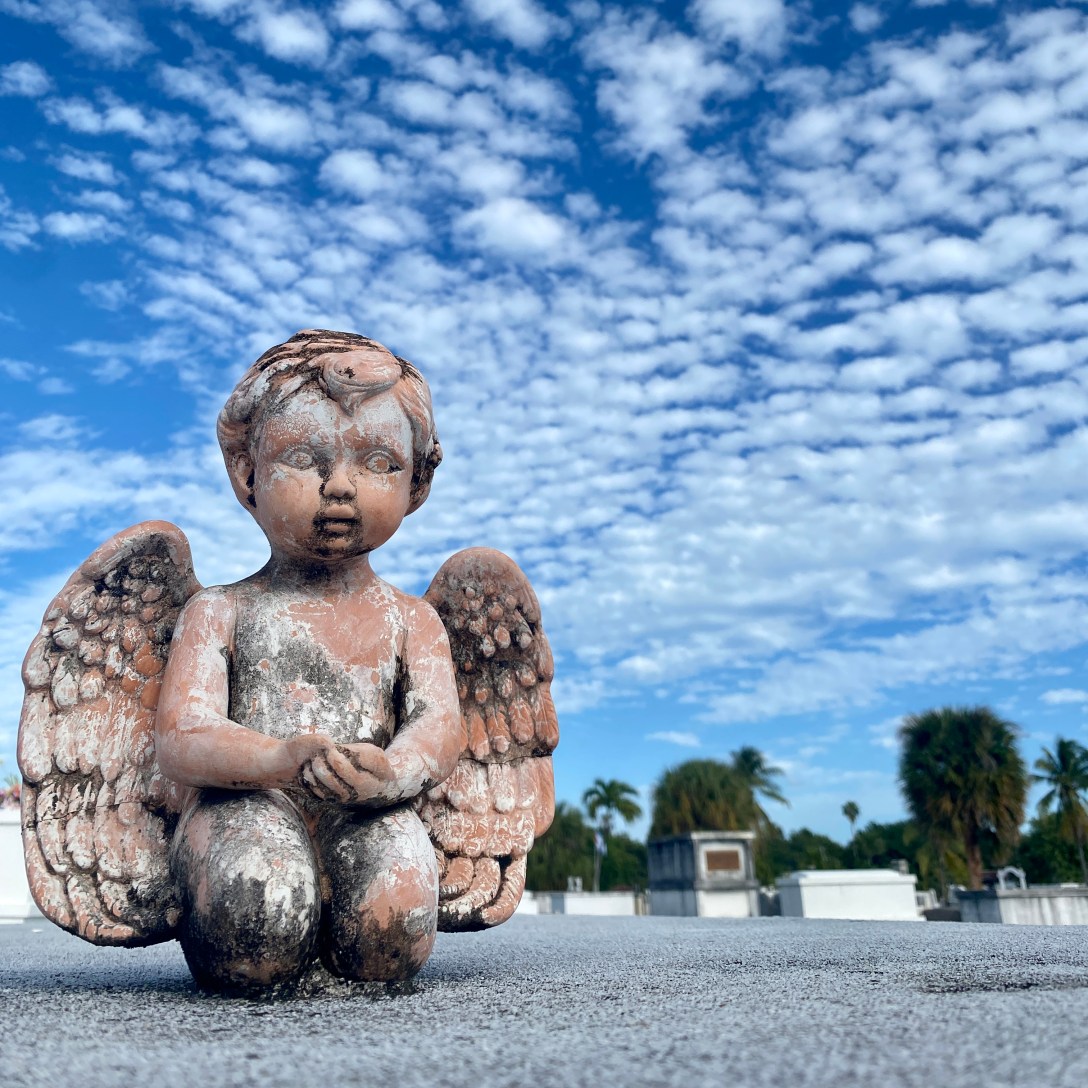
Today I wandered into an island cemetery, through palm trees and cracked stone. I felt lighter than I had in weeks. Life was demanding to be acknowledged everywhere I turned. A baby palm tree pushing up from the ground between headstones. An iguana sunning itself on a grave. A bird alighting on the head of an angel. In the cemetery, I wasn’t in a place of death at all, especially not in the sunshine, with the grass shining greenly underfoot. I was reminded of Whitman, who wrote in Song of Myself, “the smallest sprout shows there is really no death” (full excerpt is below). When I got home, I opened Rumi, searching for language to color this discovery. I found it in this poem:

Dissolver of sugar, dissolve me,
if this is the time.

Do it gently with a touch of a hand, or a look.
Every morning I wait at dawn. That’s when
it’s happened before. Or do it suddenly
like an execution. How else
can I get ready for death?

You breathe without a body like a spark.
You grieve, and I begin to feel lighter.
You keep me away with your arm,
but the keeping away is pulling me in.


While Whitman asserts that death doesn’t exist, Rumi speaks of a sudden dissolving in death, a lightness. Both reflect the feeling I had today: that death is never permanent. Something will always disintegrate and decay, and something else will always grow from the dissipated energy of the decayed thing. The graves today were filled with life. Grieving really does make us feel lighter, as Rumi notices in this near-perfect poem. Giving space to the darkness in us, being vulnerable and letting parts of ourselves die, can allow light to come in.

Full excerpt from Song of Myself (Leaves of Grass) by Whitman:
Or I guess the grass is itself a child, the produced babe of the
vegetation.
Or I guess it is a uniform hieroglyphic,
And it means,
Sprouting alike in broad zones and narrow zones,
Growing among black folks as among white,
Kanuck, Tuckahoe, Congressman, Cuff,
I give them the same, I receive them the same.

And now it seems to me the beautiful uncut hair of graves.


Tenderly will I use you curling grass,
It may be you transpire from the breasts of young men,
It may be if I had known them I would have loved them,
It may be you are from old people, or from offspring taken soon
out of their mothers’ laps,
And here you are the mothers’ laps.


This grass is very dark to be from the white heads of old mothers,
Darker than the colorless beards of old men,
Dark to come from under the faint red roofs of mouths.
O I perceive after all so many uttering tongues,
And I perceive they do not come from the roofs of mouths for
nothing.

I wish I could translate the hints about the dead young men and
women,

And the hints about old men and mothers, and the offspring taken
soon out of their laps.

What do you think has become of the young and old men?
And what do you think has become of the women and children?

They are alive and well somewhere,
The smallest sprout shows there is really no death,
And if ever there was it led forward life, and does not wait at the
end to arrest it,
And ceas’d the moment life appear’d.

All goes onward and outward, nothing collapses,

And to die is different from what any one supposed, and luckier.

On Dreams

Last night, I’m immersed in The Sopranos Season 1, Episode 2, and all of a sudden, Tony starts describing this bizarre dream he had. The dream involves a vicious bird, a lost penis, and an auto mechanic, and the whole thing makes me chuckle to myself, especially after Tony says, “and I’m holding it (his penis) up, and this bird swoops down, and grabs it in his beak, and flies off with it.” You see Tony gesturing with his hand to demonstrate the scene, then the camera immediately switches back to the therapist’s forced-imperturbable face. It’s perfect. You have to laugh.

This scene also makes me think. Why are dreams so mysterious, and so varied? Sometimes they’re ludicrous to the point of being comical. But the ludicrous can turn out to be sad. Like Tony’s ducks. He loved those ducks. He truly loved them, and truly felt a loss when they were gone. It doesn’t make any sense, and that’s okay. Sometimes (most of the time) life doesn’t make any sense at all. I know dreams are proof that we work through shit while we sleep. I also think dreams are proof that hardly anything we do, or decide, is rational.

Sometimes I wake up, terrified that what I’ve dreamed has actually happened. The feeling of relief is so magnificent when I realize I still have “control” over my life, and the terrible dream-thing did not happen. But my body has adjusted to the dream, somehow. My body has, in those few moments or hours of dreaming, accepted that the dream is real. And it takes a few moments after I wake up to readjust. Recalibrate to reality.

Sometimes I wake up with the name of a past lover still on my lips, the feeling of losing them so present in my body that it feels like we just said goodbye the day before. It is real longing, conjured up by a dream. And not only longing, but clarity as well. As if, through the experience of that relationship from the dream perspective, I have actually developed a fresh sense of myself in relation to that other being. The dream is not just some fantasy that doesn’t affect me in real life. The dream has transformed my life.

And sometimes, I wake up remembering nothing at all from my dreams.

Dreams are also tied up in memory and identity for me. I remember some of my dreams, from my childhood and teen years, as if they were memories. Fully-formed, tangible memories. You know how we change and shape our memories into stories as we remember them over and over again? Some of my older dreams are like that. I know them now like stories. They’re stories of myself. These dream memories help to form my understanding of myself, my current self, in the current world. They’re important to my identity. They’re resources for me to use, lenses through which I can filter new information.

Dreams are a portal into another realm. We might think that we’re rational beings with free will, but we seem to be operating based on much more ancient, and much less linear, program than we imagine. We like to giggle incredulously at our dreams, at the weird, nonsensical situations we create in our sleeping minds, but is reality much different?

On Teaching

I don’t often get to talk about my teaching, even though it is arguably the most important thing I do. People usually ask what shows I’m playing next, and how the album recording is coming along, but they don’t really ask me how my 15-year old student is doing on her new composition, or if my 9-year old has learned how to play minor scales yet. I guess teaching piano isn’t as glamorous as getting dressed up and rocking out onstage. But glitz isn’t everything. I think teaching a really inspiring piano lesson to just one student can be as impactful as performing for a big crowd.

When I was 19, I volunteered for a community music school in Montréal to teach free music lessons to kids in underserved boroughs outside of the city. I was fresh out of teaching piano for most of my teen years at Summer Sonatina Piano Camp, plus a couple years of private teaching out of my parents’ house in Vermont, and I was so excited to meet all of my new students. It turned out that we didn’t have enough keyboards for more than one weekly private piano lesson. So I had a single student. Their name (changed here for privacy) was Sam.

The first thing I remember about Sam was their shoulders, which they held slightly slumped forward at all times, as if trying to shrink away from something. From the way they observed me, and the little remarks they made, I could tell they were strong and intelligent, and as soon as we started lessons that intuition was confirmed. We set up our little 76-key keyboard in an empty classroom in their middle school, right in front of the chalkboard by the door. The classroom was messy, and totally ill-suited for a piano lesson, but we jumped right in anyway.

Sam had no musical experience, except for playing around on a little keyboard they had at their house. I showed them how to place their hands on the keyboard, how to keep their fingers strong while they played, and where middle C was. They absorbed everything so quickly, and so completely. I had honestly never taught a student before who could master concepts that fast. It was incredibly fun for me, and Sam was eager to play whatever pieces I brought in for them. We learned chords, scales, arpeggios, and were playing stuff hands together way sooner than I thought someone could. I think one of the last pieces I assigned was Sonatina in C by Clementi, which I usually don’t assign until I’ve been working with a student for at least a couple of years.

I remember one day, we had just sat down at the keyboard, and Sam noticed my earrings. “Why are you wearing mismatched earrings?” they asked me. I felt my earrings, trying to remember which ones I put on that morning, and they were indeed mismatching. It was something I did a lot back then, in defiance of expectations mostly, and partly simply to show people that I was a badass. I smiled. I said, “I’m wearing them because we can do whatever the hell we want. Who says earrings have to match? It’s a silly rule.” They gaped at me, then laughed. I know that message stuck with them.

I know because as the semester progressed, they started sitting down at the piano as if they belonged there. And not just a belonging at the piano. A belonging in the space they inhabited. In the world. Their shoulders weren’t slumped anymore – they sat upright, ready, alert, believing in themselves. In the beginning, they would call themselves stupid or lazy in almost every lesson. And every time, I would tell them that they were smart, hardworking, and capable. Because it was fucking true.

The music was just an avenue for me to help them find confidence in themselves. It was proof that they could excel at something. It was proof that the school system that put them in the “stupid people math classes,” as Sam would call them, was just plain wrong. They slowly realized that they had the power to do whatever the hell they want.

That’s why piano lessons are so fucking awesome.

One-Time
Monthly
Yearly

Help me continue writing & making art

Help me continue writing & making art – every month

Help me continue writing & making art – every year

Choose an amount

¤5.00
¤15.00
¤100.00
¤5.00
¤15.00
¤100.00
¤5.00
¤15.00
¤100.00

Or enter a custom amount

¤

Thank you so very much. Your generosity and support really make a difference.

Thank you so very much. Your generosity and support really make a difference.

Thank you so very much. Your generosity and support really make a difference.

DonateDonate monthlyDonate yearly

On Joy

One time, my mom gave me a book called 14,000 Things to Be Happy About. It was awesomesauce. I’ve opened it so many times, read for a couple minutes, then closed it with a knowing smile on my face. It even inspired me to ask friends and family to write their own lists of what makes them happy. To this day, I still have the notebook where I collected these various “happiness lists.” Maybe someday I’ll do something with them. Who knows.

I’m tired AF tonight, need to feel a little joy in my body, and don’t want to write anything truly coherent, so here’s my own happiness list, in no particular order:

pot roast slow-baked with beer
a new gel pen
playing a song at a show that makes someone cry
making my own stickers using colored pencils
sharing a meaningful look with a stranger as I walk by them on the sidewalk
waffles with strawberry jam
kids creating their own compositions in piano lessons
a big, clean dining room table
beautiful tea towels
using cash to buy cheap coffee
using coins from my piggybank to buy expensive ice cream
Vans sneakers
biking with someone I love
asking trees for advice
eating raw green beans
my cat’s almost obscene obsession with chasing and eating green beans
getting into bed with clean sheets
biscuits and grits
snuggling on the couch watching a movie, eating popcorn with my partner
mid-solo realizing that this shit actually sounds dope
walking along a river
flourless chocolate cake
holding hands in public
giving someone a gift I’m super excited for them to have
ice-cold lemonade
putting $40 into my retirement account
practicing piano in the morning sunlight
sweet tea
watching a really good Netflix food documentary
seeing a flower I’ve never seen before
Bananas Foster
listening to the birds
moss
eating at a fucking amazing restaurant on my birthday
dessert wine
leather jackets
long dinners with family
walking in cold weather drinking a hot drink
laughing so hard that tears stream down my face
showering after a workout
my cat’s hilarious habit of eating popcorn when I throw it for him
really, really, really, really warm socks
first snow
hugging my mom
getting paid to play music
the moment when the food arrives at the restaurant
snuggling
seeing a butterfly
walking barefoot
going to sleep after a long day of working
swimming in a lake
giving myself a hug
greenhouses
blackberries
cats in laundry baskets
the little moment when my partner joins me in bed after a long rehearsal and whispers “I love you so much” into my hair
homemade tie die shirts
Steinway pianos
balling out and choosing the whole bottle of wine at a restaurant

I could literally do this forever, so I’m gonna cut myself off there and call it a night. Make your own list! Try not to judge what comes out. It’s honestly so fun. I feel better already.