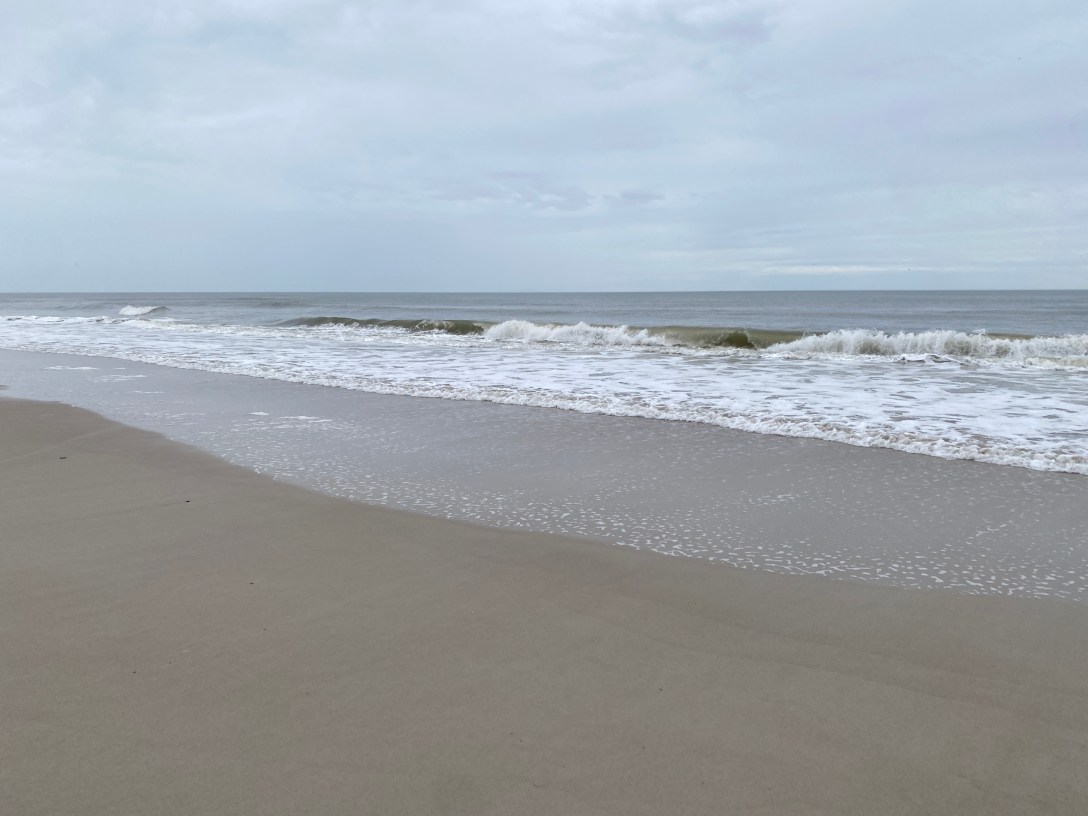
we are always changing (the ocean)

The ocean is always changing.

I’ve read that, in various forms and architectures, many times over the years. So many iterations of the same, ancient human knowledge, and yet I have never truly known, not really, until today. I don’t think I fully understand anything until I’ve experienced it, viscerally, without analysis.

The thing about the ocean is that the waves are always there, the water always has a relatively consistent chemical makeup, and the sand changes so imperceptibly that it appears to remain the same for thousands of years.

And yet.

Every single time I walk to the beach and stand facing the horizon, the ocean is new. Completely, astonishingly new. There will never be another day, and never has been, when the ocean has been this particular shade of purple as the sun rests behind charcoal grey storm clouds, or this pale, shimmering blue like the inside of an oyster shell, or this impossible frothy thing, awash with orange as the last daylight slips beyond the horizon.

She is untamable.

The crests of her waves shine with bright pleasure one day, and the next she is throwing herself against the sand in grief. Just when I think I know her, can pin her down, find a pattern, she is off again. Using some other palette, some other context. Of course, we hear that the ocean is wild, in “the literature” (to be read with a posh British accent and a sardonic smile). She is a wild, mystical beast, you cannot tame her.

I plant my feet in the sand and gaze out at the water, open to whatever she has to say. Needing a guide. Needing connection. Hoping that her magnetic dance can draw me out of the cramped body I reside in. I have collected so many barriers that it often feels like I’m wandering a maze of my own design. Each wall has helped me, protected me, in moments of extreme distress, but now I need to let some go. I need a dissolving.

And she is here. She is as ephemeral as she is powerful. Her body never stops changing. Her shape never stops shifting. Her context never stops evolving, each part responding to another part, a tapestry of overlapping elements and systems.

I face the ocean and ask her the one question I am always asking.

A vision comes back to me. It is 2018. Tara Brach is guiding me through a meditation. I bring my most heavy, unmanageable problem to the feet of my most wise self. I ask for her guidance. I surrender to presence, breathing in and out. By way of an answer, I receive an image, clear and colorful. I am standing on a grassy riverbed. I am full of something. Is it hope? Is it peace? Is it fierceness? It is something close to equanimity. My bare feet rest firmly in the grass, arms relaxed by my side, as I look slightly up and to my left. I can see my back and the slender, half-moon shape of my profile, and my hands, like dancers by my sides. I see the river, slow, dark, wide. I see all of this from ten paces behind myself, watching the energetic breeze lift my long, brown hair, my fingertips sway slightly with the movement of the wind. I am alone, and yet, I am not alone in the slightest.

I think of this now as I stand before the ocean. Is this an answer? Or simply a continuation of the question. Does having an answer matter? The cycle continues. Just as the cycle of the tide, of each wave, even, has no ending, so does this question I am asking. This need. There will never be a question and answer that satisfies the longing, just as there will never be a moment when the ocean is exactly the same as she was before.

The ocean is always changing. She is wild, untamable, a beast, a mystery. Is she so different from us, then? Is she so separate? One day I am dancing down the sidewalk in the dark, and the next I am wishing I were gone. The parade, no, the circus, of emotions, saturates my body almost every moment of every day. I am elated, now I am scared, now I am heavy with regret. Nothing is constant. Just like her.

And I smile, then, because I realize that the ocean is teaching me. And the question will be asked, and the need will be presented, over and over, and true power will be created by the cyclical movement of it all. I realize that this power, the kind that I had in my vision, comes from being a witness to it all. I realize that it is not a dissolving I need, but an opening. I realize that my feet are holding up my body, pressing firmly into the earth, and that I am looking up and slightly to my left. And I am here.

Ocean

I am in love with Ocean
lifting her thousands of white hats
in the chop of the storm,
or lying smooth and blue, the
loveliest bed in the world.
In the personal life, there is

always grief more than enough,
a heart-load for each of us
on the dusty road. I suppose
there is a reason for this, so I will be
patient, acquiescent. But I will live
nowhere except here, by Ocean, trusting
equally in all the blast and welcome
of her sorrowless, salt self.

-Mary Oliver, from Red Bird

an exploration of being wrong

I stand close to the speakers, in a swaying crowd. There are five men standing on-stage, each behind a shiny instrument, spread out in a leisurely semicircle. 

They are wearing old shirts and singing sad songs. They look nice but they’ve probably raped somebody. They probably don’t even know it. That’s how “nice” they are. 

The lead singer leans in close to the mic and introduces a song. It is a letter to his mother. It starts sweetly. The guitar accompaniment gently rocks back and forth, weaving a lullaby for every member of the audience. He sings about putting his heart on the line and getting rejected, sings that his mother told him that  “city women ain’t the same.” Nothing about the music implies that it is a violent song, or even a disturbing song. Nothing prepares me for what happens next. 

Suddenly, he sings the stanza that turns my blood to ice:

“I wish I was home, ma,

where the blue grass is growin’

and the sweet country girls don’t complain.” 

Where the girls don’t complain. 

Where the girls don’t complain. 

Where the girls don’t complain. 

Where the girls don’t complain. Where the girls don’t complain. Where the girls don’t complain Where the girls don’t complain. Where the girls don’t complain. Where the girls don’t complain. Where the girls don’t complain. Where the girls don’t complain. Where the girls don’t complain Where the girls don’t complain. Where the girls don’t complain. Where the girls don’t complain. Where the girls don’t complain. Where the girls don’t complain. Where the girls don’t complain Where the girls don’t complain. Where the girls don’t complain. Where the girls don’t complain. Where the girls don’t complain. Where the girls don’t complain. Where the girls don’t complain Where the girls don’t complain. Where the girls don’t complain. Where the girls don’t complain. Where the girls don’t complain. Where the girls don’t complain. Where the girls don’t complain Where the girls don’t complain. Where the girls don’t complain. Where the girls don’t complain. Where the girls don’t complain. Where the girls don’t complain. Where the girls don’t complain Where the girls don’t complain. Where the girls don’t complain. Where the girls don’t complain. Where the girls don’t complain. Where the girls don’t complain. Where the girls don’t complain Where the girls don’t complain. Where the girls don’t complain. Where the girls don’t complain. 

Where the girls don’t complain. 

That line digs thousands of tiny sandspurs into my throat that stick and don’t let go. I freeze. I am trapped in the familiar “triggered” state that I’ve come to know so well after years of living with Post-Traumatic Stress Disorder. 

My body is no longer at ease, no longer dancing to the beat, no longer swaying, even. I am completely still. I do not have a body anymore, or, at least, I wish I didn’t have to have one. 

I was once a girl who didn’t complain. I was hurt by men who didn’t want me to complain. I was raped by men who didn’t want me to complain. I was sexually assaulted by men who didn’t want me to complain. I continue to be consistently harassed by men who don’t want me to complain. 

As the song warbles on, every inch of my body tenses actively against the music, the words, the well-meaning men on-stage, the cheering crowd, the lights, the sounds. My jaw is clenched as tight as it goes, teeth grinding against each other, tongue stiff in my mouth. My groin is tingling in a highly disturbing way and my shoulders are full of horrible potential energy that has nowhere to go, stuck in flight but ready to fight if necessary. 

In a typical PTSD triggered state, my body can no longer tell the difference between this concert and being physically violated. They are one and the same. I feel a body on top of me, inside me, forcefully inserted years ago on a night when I didn’t complain. I feel a hand reaching down into my underwear during a bedtime story. I feel the shadow of a man looming over my sleeping body, stroking himself into my face. It is all real to me. I am getting raped all over again. I am being assaulted all over again. Except this time the man is on-stage and I am in the audience. He still has all the power. They all still have the power. I am powerless. 

In a crowd of thousands, I am fully and completely alone. I am fully and completely trapped in this body, this betrayal, this attack. Because it is, of course, an attack. 

Why has nobody noticed? My mother and my sister and all of the women around me clap and smile at the end of the song. I do not clap. I remain frozen in my spot, hands balled up into white-knuckled fists at my sides. 

“Where the blue grass is growin,’ 

and the sweet country girls don’t complain.”

What is wrong with a woman complaining? The problem is, a woman complaining has the potential to actually stop men from getting what they want. A woman complaining grants her agency, power, autonomy. Space. Desire. 

It may be a single line, but a single line is vitally important, and can be used for good. No language is neutral. “We shall overcome.” “I love you.” “Yes, we can.” These are single lines. 

Why should this man, this group of men, be exempt from taking good care of the world? 

When he sings that line, I feel the crushing weight of not complaining. I feel the sick, sick trick of internalizing every ounce of discomfort so no man ever has to experience any of it. 

I am terrified. I am disappointed. I am angry. I am so angry. 

My hands close into tight, fierce fists as the huge crowd around me claps and cheers. They clap and cheer. They gushingly approve his blatant disregard for a woman’s right to exist, to push back, to complain, to be her own autonomous being. Nobody cares that this song was written for a woman, for a mother. Nobody cares that he wrote this specific line from his mother’s perspective, from his mother’s own mouth. 

These men can stand on-stage with enough privilege to carelessly contribute to society’s oppression and subjugation of women. They can because we let them. Why is this group of men allowed to subject us to their wills, their whims, their carelessness? Why have groups of men always been allowed to subject us to their carelessness?

I never want to open my hands. I don’t want to be exposed to the air. Even that feels far too violating. The crowd is cheering on my rapist. I am surrounded by enemies. I am my own enemy. I am trapped and there is no escape.

Hours after the concert, I am still frozen, throat tight, jaw clenched, torso braced against the world, against my mother’s hug, against the air, against my existence. On the walk back to the car, I gaze over the edge of a tall bridge and imagine myself throwing myself over the railing, intentional and final. How would I fall on the concrete below? Would I die or would I simply break my legs? I long to do it. I catch myself imagining suicide and feel ashamed, simultaneously wishing that somebody would notice, while also hoping that nobody will notice.

I try to get through. I try to act like myself around my family. I worry that I am causing them pain by talking like I’m made of cardboard. I try not to breathe too much. I try to stay as still as possible so that the anger and horror inside me don’t slip out. So nobody sees how terrified I am to exist. 

How can I explain it? I am ashamed of my PTSD symptoms. I am ashamed of the strength of my reaction to a simple song lyric. I am ashamed that I spent the last part of the concert not enjoying myself. I didn’t “make the most of the moment.” I am ashamed of my body, of the way it veers away from every soft thing, from every breath. 

I can get triggered at any moment. When I am triggered, my survival brain hijacks the rest of my body, seeing a threat and going into freeze mode. In this case, the threat was a man declaring that a woman who complains is undesirable, and therefore wrong. A woman who complains is hurtful. A woman who complains throws the balance off. A woman who complains makes herself known. She takes up her own space. 

A woman who complains exists. 

A woman who exists is wrong. I exist and I am wrong. 

I am wrong. 

I am wrong. 

I am wrong.

Seven Years Can Be a Lifetime

Dear Twenty-Year Old Me, 

I know it’s been awhile since you felt loved. I was with you in your bedroom on your birthday that night on Dorset Street. You were listening to “I Hope You Dance Radio” on Pandora while ripping off curls of blue and pink wrapping paper from the boxes. I saw you crying, heaving with sobs over the small piles of tufted paper and ribbon. I could see that you were hurting. I loved you then. 

I know you wanted somebody to see, and you also hoped so fervently that nobody would see. I was there with you when you downed a bottle of red wine on a Thursday night, taking big gulps straight from the bottle, blasting “Can’t Take My Eyes Off You” by Frankie Vallie on your iHome. I loved how you twirled around the room, screaming into the wine bottle as a microphone. I loved you then. 

I know you feel so alone. I can see your core, glimmering like well-loved embers, but I can see that you have no access to it at all. I heard your footsteps as you padded down his hall late at night, feeling a hard knot in the pit of your stomach, approaching the inevitable atrophy of your self-esteem with grim dedication. I loved you then. 

I know you do not feel like yourself. I was with you as you crouched in the corner of his kitchen, exploding with rage and terror, screaming out expletives about love and devotion. You succumbed to the hurt, cowering animal inside you. You spit and snarled. You clawed at the air. You couldn’t expand your body enough to express the weight of your anger. I loved you then. 

I hear you. You are so afraid that you don’t exist. I hear you. You are so tired. I hear you. You feel eighty years old and you are only twenty. I know you are tired. I am always here with you. I will never leave you. I will love you forever. 

With all of my love, 

Twenty-Seven Year Old Me

we are the subject, not the object

I was.
I wanted.
I came.
I remember.
I felt.
I wanted.
I needed.
I conducted.
I made.
I wanted.
I knew.
I lived.

I was afraid.
I was listening.
I wanted to be free.
I came across myself many times over.
I remembered.
I felt myself forgetting.
I wanted to be good.
I needed everything.
I conducted ceremonies.
I climbed up, even as I dreaded falling off.
I made myself jump.
I wanted wholeness.
I knew I would always be leaving a version of myself behind.
I lived anyway.

all this will be ruins

All this will be ruins someday. The earth re-membering herself, re-calling her own Name. All this will be ruins someday. The bright red METRO MATTRESS DISCOUNT SLEEP SUPERSTORE sign will crack and sink into the soft forgiveness of the mud. Every Grande styrofoam cup will slowly settle beneath the dirt, snap into pieces, become one with bulging roots and galaxies of mycelium. There will be no plastic left, only vivid tangles of roots. Swelling. Sighing. It will all be ruins.

All this will be ruins someday. Every desperate, pavement-sodden parking lot will cry out in relief as burbling streams find their way through the concrete, saplings shove themselves up between tiny crevices, and grass sprouts up, along the perimeter, now in the middle, now in every possible direction. It will all be ruins.

All this will be ruins someday. Ruin, from the Latin word “ruere,” meaning “to fall violently,” turning into an Old English word meaning “act of giving way” and the Italian word “rovina,” meaning “to knock down, tear out, or dig up.” Ruins. What a relief to release the burden of progress and productivity. It will all be ruins.

All this will be ruins someday. A re-in-statement of the natural order of things. A letting-go of the chokehold we have on the world, this dangerous and exhausting myth of control. A digging up of all that we have imposed on Her. All this will be ruins someday.

May that day come sooner, rather than later.

how tempting it is

How tempting it is to build a monument to our pain, a towering monolith of trauma, a permanent tattoo of our losses. “Look,” we call, “look at how you have ravaged my soul. Look at my body in tatters.” How we forget that we are already building the most powerful monument: the story of how we have gathered ourselves up again, yawning piece by yawning piece, warming our bodies around a new, infallible belief in ourselves, expanding as our disfigured mouths grow pink and taut with healing. “We are here,” we call, “we are here, whether you see us or not.”

On Shrek

We all watched Shrek and fell in love with the characters, humor, and revolutionary animation style. I saw it for the first time in the theater with my grandfather. I was entranced. It was the first time I’d seen such realistic animation, and I was completely enamored with the fart jokes, hilarious donkey, and tale of fairytale romance. Shrek even introduced me to one of my favorite songs: Hallelujah, by Leonard Cohen.

I’ve rewatched Shrek many times since then. At first, it was just a nostalgic activity. But recently, it’s turned into an anthropological study for me. What cultural values was the movie pushing? What had I unknowingly absorbed as a kid watching Shrek?

The answer? Shrek was one of the many movies I watched as a kid that normalized, and made light of, abuse.

On the surface, the movie does seem to subvert the misogyny that exists in most classic Western fairytales. Fiona is a strong, badass woman who can take care of herself. She fights for herself, saves Shrek and Donkey from thieves on the road, and finds her own dwellings at night. That’s how I saw it at first too. But, the deeper messaging of Shrek does NOT support that surface-level story. Here are a few examples, taken from throughout the film, that proves the movie doesn’t actually subvert the original misogyny/patriarchal system at all, but supports it throughout.

1) In this scene, Fiona says “who could love a hideous, ugly beast” when speaking with Donkey towards the end of the movie. She truly believes that she is unloveable as an ogre (which is to say, she believes that she is unloveable as she is). It is not until the very end, when Shrek (a male character) tells her that she is beautiful, and that he wants her in whatever form she takes, that she seems to accept herself as she is, in her ogre form.

Fiona does not even have the confidence to assert herself in the conversation with Shrek following her secret discussion with Donkey about her being an ogre. Because of her true belief that she is unloveable and ugly, she assumes he’s talking about her when he repeats her words back to her: “who could love a hideous, ugly beast.” She doesn’t dig deeper into the issue. Shrek confirmed her greatest fear – that she won’t get what she wants (love) because she is not enough. She doesn’t deserve love. She doesn’t deserve desire. She doesn’t deserve a self.

Fiona was NOT, prior to the scene where Shrek interrupts the wedding and confesses his love, confident in herself. She hid this terrible secret, that she was UGLY, from all the other characters, every single night. The fact that she was ugly was shameful to her. The movie depicts a woman who does not have a strong sense of self, and cannot validate her own existence. She only validates herself when a man tells her that she is valid.

2) Fiona DOES have to be saved at the end of the film. When she perceives that Shrek has rejected her, she leaves to go marry Lord Farquad. Because that is what a man told her she has to do. The movie gives her two choices: be with one man who despises you (as she thinks Shrek does) or be with another man who you despise (Lord Farquad). There’s no third option, and it’s very important to realize that the movie does not depict her creating a third option for herself.

At the end, Shrek has to save her from being with Lord Farquad by interrupting the wedding. She made no decisions, except to accept Shrek’s offer. This is key: before Shrek assured her that he thought she was beautiful, she was unwilling to put herself out there to be with the one she loved. She was so insecure that she was resigned to be with a mean, ugly man, rather than get what she wanted: to be with Shrek. She needed a man’s validation to feel she deserved what she desired. In this way, Shrek did actually save her at the end. Fiona did not have agency in their romantic relationship. Shrek did.

3) Who were the other female characters in the movie? There are only three. Princess Fiona, the Dragon, and the Old Woman who sells the talking Donkey. Snow White and Cinderella are not characters in movie 1, since they’re just depicted on a screen for a couple seconds. Princess Fiona is not shown in a community of other women who are equally strong and able to take care of themselves. If she was, I would accept the claim that the movie depicts a badass woman, and therefore subverts the fairytale image of femaleness. However, Princess Fiona is an outlier. She’s shocking. Based on the movie’s depiction of female characters, she could be the only woman of her kind in the history of the universe, and the only woman of her kind in the foreseeable future.

None of the other female characters do anything besides display the regular tropes of weak, untrustworthy, and helpless femaleness. The Old Woman who sells Donkey is not taken seriously by the guards. They don’t believe her that Donkey talks. She is manhandled by the guards and never gets rewarded for the Donkey because he (the male character) saves himself. We never see this woman getting what she wants – money to support herself. She has no agency. Instead, we follow the male character, the Donkey, on his subsequent adventure.

The Dragon is a promising female character, because she can breath fire and goes right for what she wants: a romantic relationship with Donkey. However, she has no agency in her own world, either. She is extremely unhappy, forced to remain chained in the castle all on her own. She is incredibly lonely, and after Shrek, Donkey and Fiona escape her clutches, we don’t see an angry, aggressive female character. Instead, we see a sad one that longs for a life outside of her chains. She is a slave until Donkey comes to rescue her.

In contrast to the lack of female characters, there are MANY male characters, with a variety of personalities and storylines. “Maleness” is very fleshed out in this movie. There’s Shrek, Donkey, Lord Farquad, The Three Blind Mice… the list goes on and on and on.

There are literally no other female characters in the movie. So maybe on the surface, Fiona seems all badass and capable because she can fight and take care of herself, but that’s not the messaging we’re really receiving. The messaging we’re receiving is that she is an unusual case – not the norm. The movie doesn’t normalize her supposedly strong female nature.

4) Take a look at this scene from the movie, in which the Magic Mirror presents three eligible bachelorettes for Lord Farquad to marry. The Mirror makes a blatant joke about abuse, describing Cinderella as a “mentally-abused shut-in from a kingdom far, far away,” as if being mentally abused is not something to be concerned about. Then, we hear that Snow White lives with seven other men, but “she’s not easy.” The Mirror’s casual judgement of Snow White’s sexuality normalizes diminishing a women’s worth to her sexual tendencies and sexuality.

Diminishing women to sexual beings makes it much easier to abuse us.

But that’s not all. The Mirror continues, inviting Lord Farquad to “kiss her dead, frozen lips and find out what a live wire she is! Come on!” Then you hear a drum set go “ba dum smash,” which officially turns this image of treating a dead woman like a sex toy into a joke. This image should be disturbing, but the movie turns it into something funny. Once again, Shrek normalizes powerless women without agency: easy targets for abuse.

Disguised in jokes, it’s easy to miss how dangerous this normalization is. Boys and girls watching this absorb the following messages:
1) abused women are funny
2) women are just sexual playthings
3) a woman who cannot consent is fair game for sexual activities

5) In another scene, Donkey and Shrek finally arrive at the castle Fiona is trapped in. Donkey asks, “So where is this fire-breathing, pain-in-the-neck anyway?” Shrek responds, saying, “Inside, waiting for us to rescue her.” I know it’s been discussed a lot, but I have to talk about the problematic message this sends. Shrek’s response assumes that there is a helpless woman inside the castle waiting for a man to rescue her. It takes away agency from women in our culture, showing us that we are not capable of taking care of ourselves. This is dangerous because it gives men permission to control our lives – if women don’t have any agency, we don’t have any right to say no or argue with a man’s opinion/action in our lives. It might be “rescuing” one day, but it could be something much less desirable the next. And what if we don’t need to be saved?

Yes, “rescuing the princess” is a classic fairytale trope. I don’t care. it needs to change. Luckily, movies like Tangled and Brave have JUST STARTED to unravel this dangerous message.

Then, as if that’s not enough negative messaging, Donkey delivers the punchline. After he asks “where is this fire-breathing, pain-in-the-neck anyway?” and Shrek responds “waiting for us to rescue her,” Donkey retorts, “I was talking about the dragon, Shrek.” This joke, laughing at a woman’s needs and display of anger, is so overused and so damaging. It’s the Eve story. Eve gives in to temptation and eats the fruit she’s not supposed to eat. This woman’s desire is the downfall of man. Women are evil. Women are a “pain in the ass,” in the words of Shrek. It’s not difficult to make the leap to “we should hate women” and “we don’t need to take any woman’s needs seriously.” Again, Shrek writers manage to turn “stripping women of their power” into a joke, as if it’s suddenly okay because they’re joking about it.

Shrek paints a truly disturbing image of what a woman is in our society. She is powerless, hated, needs others to validate her experience, and doesn’t need to consent to be touched by you. She is, in other words, extremely susceptible to abuse. This is a MOVIE FOR KIDS. And it’s contributing to abuse culture by NORMALIZING WOMEN WITH NO AGENCY.

I am not, by any means, discounting Shrek as a movie. I don’t believe in cancel culture – I think things are always so much more nuanced than that. The movie really does bring me so much joy, even watching it this new perspective, even after the abuse I’ve experienced at the hands of multiple men.

But. I think it’s important to recognize this dangerous, deeper messaging. Why is it important? Because I know for a fact that it’s watching innocuous movies like this, that hide true misogyny behind a surface-level strong female character story arch, that led to me thinking it was OKAY TO BE ABUSED. Abuse culture is serious and needs to be examined from every angle. Even a movie we all know and love so much. I’ve been rewatching a lot of the movies I watched when I was a kid, and noticing similar messaging popping up in almost every movie. Abuse culture was very prevalent in the media I consumed as a kid, and there was nothing my parents or school could do to reverse that. It was just…there. I just absorbed it.

And I haven’t even started discussing the way “Blackness,” as well as the complete lack of female Blackness, is portrayed in this movie. That’s a whole other conversation and blog post.

On Body Image

I’m a female musician. That means that in addition to being an incredible musician, I have to be beautiful and toned to be respected. When male hosts introduce me before I come onstage, they often say “the beautiful and talented Siena,” as if somehow saying that I’m beautiful is an adequate introduction to my music. The fact that I’m beautiful actually has nothing at all to do with my music, yet it’s an unspoken requirement that I must stay beautiful to get noticed.

My male counterparts can go out with scruffy hair, unshaven faces, potbellies, and outfits that look like they’ve been slept in. I’ve seen it. Too many times. They can look as ridiculous as they want, and people just focus on the quality of the music they’re playing. But if a female musician goes out with even the hint of a muffin-top, people wonder if she’s really serious about her craft. People start to give unsolicited advice about her weight, about her work ethic, about how much time she’s spending with her family, and about her character. They talk about these things instead of the music she’s creating and putting out into the world.

Yes, there are female artists like Billie Eilish, Lizzo, and Kelly Clarkson who are actively pushing back against the scrutiny that female performers are under about our bodies. Is it enough to make me relax and “let my body go?” No. Plus, I’m speaking as a white woman: I can’t even begin to speak to the much harsher scrutiny of Black female musicians.

So why is it like this? Where does this pressure come from? Let’s take Women’s Health Magazine as just a small example of the cultural prevalence of scrutinizing women’s bodies. First of all, “health” is in the title, but this publication focuses mostly on diet and weight loss. It equates health with being super thin and toned. This is bullshit. Health is not the perfect body. Health is not obese, either. Health is somewhere in between. Health has nothing whatsoever to do with how we appear, past a certain threshhold (obviously someone with a grey and clammy complexion isn’t doing too well).

In an article about Lady Gaga’s body in her 2017 Super Bowl HalfTime performance, Women’s Health Mag tried to claim that people shouldn’t (and generally don’t) scrutinize the bodies of female performers. The magazine paints a utopian portrait of a world that doesn’t care how a woman looks. This is just simply false. You can read Fox’s report on the actual comments made on Twitter about Gaga’s body. Everyone, including women, scrutinize women’s bodies. I do it, you do it. We all do it. Some see an imperfect female body and say “it’s too bad she let herself go.” Some just subconsciously respect her a little less. They think she doesn’t deserve their respect because she doesn’t respect herself enough to starve herself and work out for hours each day.

Even WHILE Women’s Health Mag describes this fantasy world where society is beyond criticizing women’s bodies, they display other shit that reveals quite the opposite. Literally on the same page. Here’s a smattering of other stuff you’ll encounter as you scroll through this article:
1) a video explaining “Grocery Shopping for a Healthy Lifestyle,” which dictates how to to avoid tempting bakery items that are sure to “derail your diet” by carefully planning your route in a grocery store, all while depicting extremely thin women picking up fruits, vegetables and, of course, Grape Nuts
2) the “Workout Advice” section at the bottom of the page, which boasts results like “visibly toned abs” and “sculpted arms”
3) the “Must-Have Fall Athleisure Styles” section, showing a sporty woman looking alluringly at the camera

Clearly, Women’s Health Mag knows that women are CONSTANTLY under the scrutiny of the public. They not only know it, but they are actually making a shit-ton of money off of that reality. Despite reporting in another article that “when people (feel) bad about their bodies, they (are) more likely to experience…a cluster of health issues,” the magazine proceeds to make women feel bad about their bodies throughout their website. Here’s the cherry on top: down at the bottom of the screen in small letters, you can click a link that reads “PEOPLE WITH THIS TRAIT HAVE SMALLER HIPS AND BELLIES.” This ‘enticing’ (and shaming) headline leads to a page that displays an ad for “Belly Rehab” and plenty of “How to Lose Weight” articles. So much for us living in a world where shaming Lady Gaga for having stomach flab is outrageous, blasphemous, and “unheard of.” The haters are here to stay, folks.

I’m not sure how to navigate this world. I’m not ready yet to give up the patriarchal idea I’ve been brainwashed with: that I have to look “good” (aka not flabby) to be taken seriously in the music world as a female musician.