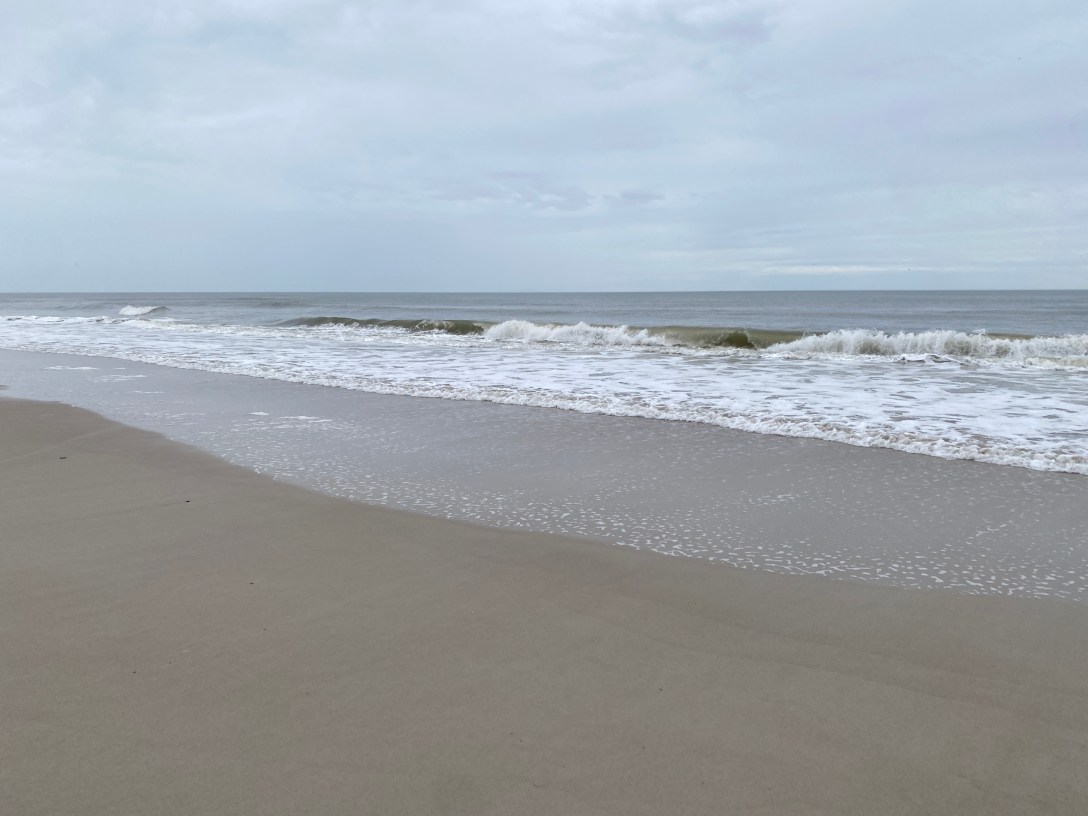
we are always changing (the ocean)

The ocean is always changing.

I’ve read that, in various forms and architectures, many times over the years. So many iterations of the same, ancient human knowledge, and yet I have never truly known, not really, until today. I don’t think I fully understand anything until I’ve experienced it, viscerally, without analysis.

The thing about the ocean is that the waves are always there, the water always has a relatively consistent chemical makeup, and the sand changes so imperceptibly that it appears to remain the same for thousands of years.

And yet.

Every single time I walk to the beach and stand facing the horizon, the ocean is new. Completely, astonishingly new. There will never be another day, and never has been, when the ocean has been this particular shade of purple as the sun rests behind charcoal grey storm clouds, or this pale, shimmering blue like the inside of an oyster shell, or this impossible frothy thing, awash with orange as the last daylight slips beyond the horizon.

She is untamable.

The crests of her waves shine with bright pleasure one day, and the next she is throwing herself against the sand in grief. Just when I think I know her, can pin her down, find a pattern, she is off again. Using some other palette, some other context. Of course, we hear that the ocean is wild, in “the literature” (to be read with a posh British accent and a sardonic smile). She is a wild, mystical beast, you cannot tame her.

I plant my feet in the sand and gaze out at the water, open to whatever she has to say. Needing a guide. Needing connection. Hoping that her magnetic dance can draw me out of the cramped body I reside in. I have collected so many barriers that it often feels like I’m wandering a maze of my own design. Each wall has helped me, protected me, in moments of extreme distress, but now I need to let some go. I need a dissolving.

And she is here. She is as ephemeral as she is powerful. Her body never stops changing. Her shape never stops shifting. Her context never stops evolving, each part responding to another part, a tapestry of overlapping elements and systems.

I face the ocean and ask her the one question I am always asking.

A vision comes back to me. It is 2018. Tara Brach is guiding me through a meditation. I bring my most heavy, unmanageable problem to the feet of my most wise self. I ask for her guidance. I surrender to presence, breathing in and out. By way of an answer, I receive an image, clear and colorful. I am standing on a grassy riverbed. I am full of something. Is it hope? Is it peace? Is it fierceness? It is something close to equanimity. My bare feet rest firmly in the grass, arms relaxed by my side, as I look slightly up and to my left. I can see my back and the slender, half-moon shape of my profile, and my hands, like dancers by my sides. I see the river, slow, dark, wide. I see all of this from ten paces behind myself, watching the energetic breeze lift my long, brown hair, my fingertips sway slightly with the movement of the wind. I am alone, and yet, I am not alone in the slightest.

I think of this now as I stand before the ocean. Is this an answer? Or simply a continuation of the question. Does having an answer matter? The cycle continues. Just as the cycle of the tide, of each wave, even, has no ending, so does this question I am asking. This need. There will never be a question and answer that satisfies the longing, just as there will never be a moment when the ocean is exactly the same as she was before.

The ocean is always changing. She is wild, untamable, a beast, a mystery. Is she so different from us, then? Is she so separate? One day I am dancing down the sidewalk in the dark, and the next I am wishing I were gone. The parade, no, the circus, of emotions, saturates my body almost every moment of every day. I am elated, now I am scared, now I am heavy with regret. Nothing is constant. Just like her.

And I smile, then, because I realize that the ocean is teaching me. And the question will be asked, and the need will be presented, over and over, and true power will be created by the cyclical movement of it all. I realize that this power, the kind that I had in my vision, comes from being a witness to it all. I realize that it is not a dissolving I need, but an opening. I realize that my feet are holding up my body, pressing firmly into the earth, and that I am looking up and slightly to my left. And I am here.

Ocean

I am in love with Ocean
lifting her thousands of white hats
in the chop of the storm,
or lying smooth and blue, the
loveliest bed in the world.
In the personal life, there is

always grief more than enough,
a heart-load for each of us
on the dusty road. I suppose
there is a reason for this, so I will be
patient, acquiescent. But I will live
nowhere except here, by Ocean, trusting
equally in all the blast and welcome
of her sorrowless, salt self.

-Mary Oliver, from Red Bird

an exploration of being wrong

I stand close to the speakers, in a swaying crowd. There are five men standing on-stage, each behind a shiny instrument, spread out in a leisurely semicircle. 

They are wearing old shirts and singing sad songs. They look nice but they’ve probably raped somebody. They probably don’t even know it. That’s how “nice” they are. 

The lead singer leans in close to the mic and introduces a song. It is a letter to his mother. It starts sweetly. The guitar accompaniment gently rocks back and forth, weaving a lullaby for every member of the audience. He sings about putting his heart on the line and getting rejected, sings that his mother told him that  “city women ain’t the same.” Nothing about the music implies that it is a violent song, or even a disturbing song. Nothing prepares me for what happens next. 

Suddenly, he sings the stanza that turns my blood to ice:

“I wish I was home, ma,

where the blue grass is growin’

and the sweet country girls don’t complain.” 

Where the girls don’t complain. 

Where the girls don’t complain. 

Where the girls don’t complain. 

Where the girls don’t complain. Where the girls don’t complain. Where the girls don’t complain Where the girls don’t complain. Where the girls don’t complain. Where the girls don’t complain. Where the girls don’t complain. Where the girls don’t complain. Where the girls don’t complain Where the girls don’t complain. Where the girls don’t complain. Where the girls don’t complain. Where the girls don’t complain. Where the girls don’t complain. Where the girls don’t complain Where the girls don’t complain. Where the girls don’t complain. Where the girls don’t complain. Where the girls don’t complain. Where the girls don’t complain. Where the girls don’t complain Where the girls don’t complain. Where the girls don’t complain. Where the girls don’t complain. Where the girls don’t complain. Where the girls don’t complain. Where the girls don’t complain Where the girls don’t complain. Where the girls don’t complain. Where the girls don’t complain. Where the girls don’t complain. Where the girls don’t complain. Where the girls don’t complain Where the girls don’t complain. Where the girls don’t complain. Where the girls don’t complain. Where the girls don’t complain. Where the girls don’t complain. Where the girls don’t complain Where the girls don’t complain. Where the girls don’t complain. Where the girls don’t complain. 

Where the girls don’t complain. 

That line digs thousands of tiny sandspurs into my throat that stick and don’t let go. I freeze. I am trapped in the familiar “triggered” state that I’ve come to know so well after years of living with Post-Traumatic Stress Disorder. 

My body is no longer at ease, no longer dancing to the beat, no longer swaying, even. I am completely still. I do not have a body anymore, or, at least, I wish I didn’t have to have one. 

I was once a girl who didn’t complain. I was hurt by men who didn’t want me to complain. I was raped by men who didn’t want me to complain. I was sexually assaulted by men who didn’t want me to complain. I continue to be consistently harassed by men who don’t want me to complain. 

As the song warbles on, every inch of my body tenses actively against the music, the words, the well-meaning men on-stage, the cheering crowd, the lights, the sounds. My jaw is clenched as tight as it goes, teeth grinding against each other, tongue stiff in my mouth. My groin is tingling in a highly disturbing way and my shoulders are full of horrible potential energy that has nowhere to go, stuck in flight but ready to fight if necessary. 

In a typical PTSD triggered state, my body can no longer tell the difference between this concert and being physically violated. They are one and the same. I feel a body on top of me, inside me, forcefully inserted years ago on a night when I didn’t complain. I feel a hand reaching down into my underwear during a bedtime story. I feel the shadow of a man looming over my sleeping body, stroking himself into my face. It is all real to me. I am getting raped all over again. I am being assaulted all over again. Except this time the man is on-stage and I am in the audience. He still has all the power. They all still have the power. I am powerless. 

In a crowd of thousands, I am fully and completely alone. I am fully and completely trapped in this body, this betrayal, this attack. Because it is, of course, an attack. 

Why has nobody noticed? My mother and my sister and all of the women around me clap and smile at the end of the song. I do not clap. I remain frozen in my spot, hands balled up into white-knuckled fists at my sides. 

“Where the blue grass is growin,’ 

and the sweet country girls don’t complain.”

What is wrong with a woman complaining? The problem is, a woman complaining has the potential to actually stop men from getting what they want. A woman complaining grants her agency, power, autonomy. Space. Desire. 

It may be a single line, but a single line is vitally important, and can be used for good. No language is neutral. “We shall overcome.” “I love you.” “Yes, we can.” These are single lines. 

Why should this man, this group of men, be exempt from taking good care of the world? 

When he sings that line, I feel the crushing weight of not complaining. I feel the sick, sick trick of internalizing every ounce of discomfort so no man ever has to experience any of it. 

I am terrified. I am disappointed. I am angry. I am so angry. 

My hands close into tight, fierce fists as the huge crowd around me claps and cheers. They clap and cheer. They gushingly approve his blatant disregard for a woman’s right to exist, to push back, to complain, to be her own autonomous being. Nobody cares that this song was written for a woman, for a mother. Nobody cares that he wrote this specific line from his mother’s perspective, from his mother’s own mouth. 

These men can stand on-stage with enough privilege to carelessly contribute to society’s oppression and subjugation of women. They can because we let them. Why is this group of men allowed to subject us to their wills, their whims, their carelessness? Why have groups of men always been allowed to subject us to their carelessness?

I never want to open my hands. I don’t want to be exposed to the air. Even that feels far too violating. The crowd is cheering on my rapist. I am surrounded by enemies. I am my own enemy. I am trapped and there is no escape.

Hours after the concert, I am still frozen, throat tight, jaw clenched, torso braced against the world, against my mother’s hug, against the air, against my existence. On the walk back to the car, I gaze over the edge of a tall bridge and imagine myself throwing myself over the railing, intentional and final. How would I fall on the concrete below? Would I die or would I simply break my legs? I long to do it. I catch myself imagining suicide and feel ashamed, simultaneously wishing that somebody would notice, while also hoping that nobody will notice.

I try to get through. I try to act like myself around my family. I worry that I am causing them pain by talking like I’m made of cardboard. I try not to breathe too much. I try to stay as still as possible so that the anger and horror inside me don’t slip out. So nobody sees how terrified I am to exist. 

How can I explain it? I am ashamed of my PTSD symptoms. I am ashamed of the strength of my reaction to a simple song lyric. I am ashamed that I spent the last part of the concert not enjoying myself. I didn’t “make the most of the moment.” I am ashamed of my body, of the way it veers away from every soft thing, from every breath. 

I can get triggered at any moment. When I am triggered, my survival brain hijacks the rest of my body, seeing a threat and going into freeze mode. In this case, the threat was a man declaring that a woman who complains is undesirable, and therefore wrong. A woman who complains is hurtful. A woman who complains throws the balance off. A woman who complains makes herself known. She takes up her own space. 

A woman who complains exists. 

A woman who exists is wrong. I exist and I am wrong. 

I am wrong. 

I am wrong. 

I am wrong.

Seven Years Can Be a Lifetime

Dear Twenty-Year Old Me, 

I know it’s been awhile since you felt loved. I was with you in your bedroom on your birthday that night on Dorset Street. You were listening to “I Hope You Dance Radio” on Pandora while ripping off curls of blue and pink wrapping paper from the boxes. I saw you crying, heaving with sobs over the small piles of tufted paper and ribbon. I could see that you were hurting. I loved you then. 

I know you wanted somebody to see, and you also hoped so fervently that nobody would see. I was there with you when you downed a bottle of red wine on a Thursday night, taking big gulps straight from the bottle, blasting “Can’t Take My Eyes Off You” by Frankie Vallie on your iHome. I loved how you twirled around the room, screaming into the wine bottle as a microphone. I loved you then. 

I know you feel so alone. I can see your core, glimmering like well-loved embers, but I can see that you have no access to it at all. I heard your footsteps as you padded down his hall late at night, feeling a hard knot in the pit of your stomach, approaching the inevitable atrophy of your self-esteem with grim dedication. I loved you then. 

I know you do not feel like yourself. I was with you as you crouched in the corner of his kitchen, exploding with rage and terror, screaming out expletives about love and devotion. You succumbed to the hurt, cowering animal inside you. You spit and snarled. You clawed at the air. You couldn’t expand your body enough to express the weight of your anger. I loved you then. 

I hear you. You are so afraid that you don’t exist. I hear you. You are so tired. I hear you. You feel eighty years old and you are only twenty. I know you are tired. I am always here with you. I will never leave you. I will love you forever. 

With all of my love, 

Twenty-Seven Year Old Me

Security is Surrender

It is astounding to me how much I have grasped at security. I have believed that in order to secure my future, I need to live small and tidy in the present. I have nursed anxieties about “not having enough” and “not being enough” and “not doing enough.” Grasping at security offers the illusion of control. If I can just make everything good enough, if I can settle into something, then I have control over my life, my existence, the lives of my beloveds. But this isn’t true, is it? Why is it that I insist on keeping up this ridiculous charade of control?

We do not know if we will be alive tomorrow. We do not know if we will be alive one minute from now. We do not know if our friends and family will be here, either.

What is “security,” then, really? What does security look like amidst all of these truths?

Perhaps, faced with this question, we are drawn to admit that we know nothing. That we control nothing. That, in fact, security does not exist.

Or, perhaps, we are drawn to redefine security.

Security is possessing the ability to access your core self, maintaining a direct line to your life force.

Security is staying curious, and receptive towards, perspectives on the world that differ from your own.

Security is allowing your desire to shine out of your body, to play, to explore, to keep you safe.

Perhaps, faced with these truths, we are led to a different conclusion entirely: security is surrender. How might we live our lives, love our people, do our work, if we truly believe that to be secure is to be like water, not hard stone? Even hard stone gives way eventually to the current.

we are the subject, not the object

I was.
I wanted.
I came.
I remember.
I felt.
I wanted.
I needed.
I conducted.
I made.
I wanted.
I knew.
I lived.

I was afraid.
I was listening.
I wanted to be free.
I came across myself many times over.
I remembered.
I felt myself forgetting.
I wanted to be good.
I needed everything.
I conducted ceremonies.
I climbed up, even as I dreaded falling off.
I made myself jump.
I wanted wholeness.
I knew I would always be leaving a version of myself behind.
I lived anyway.

what am I learning to love?

Love. How this word eats away at us. How we long for the definition, some clarity, something to land in. Is it too cruel to say that landing in love is a myth? Learning to love, on the other hand, is the entirety of it. So, as I answer this question, I will be contemplating love in its entirety, in all the dark, damp layers of it. I’m learning to love the routine of folding laundry slowly over the course of the weekend. I’m learning to love the feeling of grief when another tiny seedling dies for no apparent reason. I’m learning to love the click of cheap shades against the windowsill, as the spring wind laps at the side of our house. I’m learning to love the revision process for each blog post I write for all the small business owners looking for SEO bolstering. I’m learning to love the feeling of collapsing into bed after a day of frayed nerves and lingering hugs. I’m learning to love chopping vegetables for strange stews while my fiancé practices snare drum etudes in the studio. I’m learning to love growing herbs on the windowsill. I’m learning to love saying hi to people on their porches as I walk past. I’m learning to love being financially stable for the first time in my independent adult life. I’m learning to love my fiancé’s stubbornness in the face of change. I’m learning to love my self-judgement. I’m learning to love the possibility of rest and rejuvenation. I’m learning to love the rain again. I’m learning to love uncertainty, of not knowing, of not fully understanding. I’m learning to love those moments when I cannot hold myself up for crying so much. I’m learning to love my integrity. I’m learning to love saying no to things I cannot or do not want to take on. I’m learning to love the place where “humanness” and “nature” touch noses and swirl into one another.